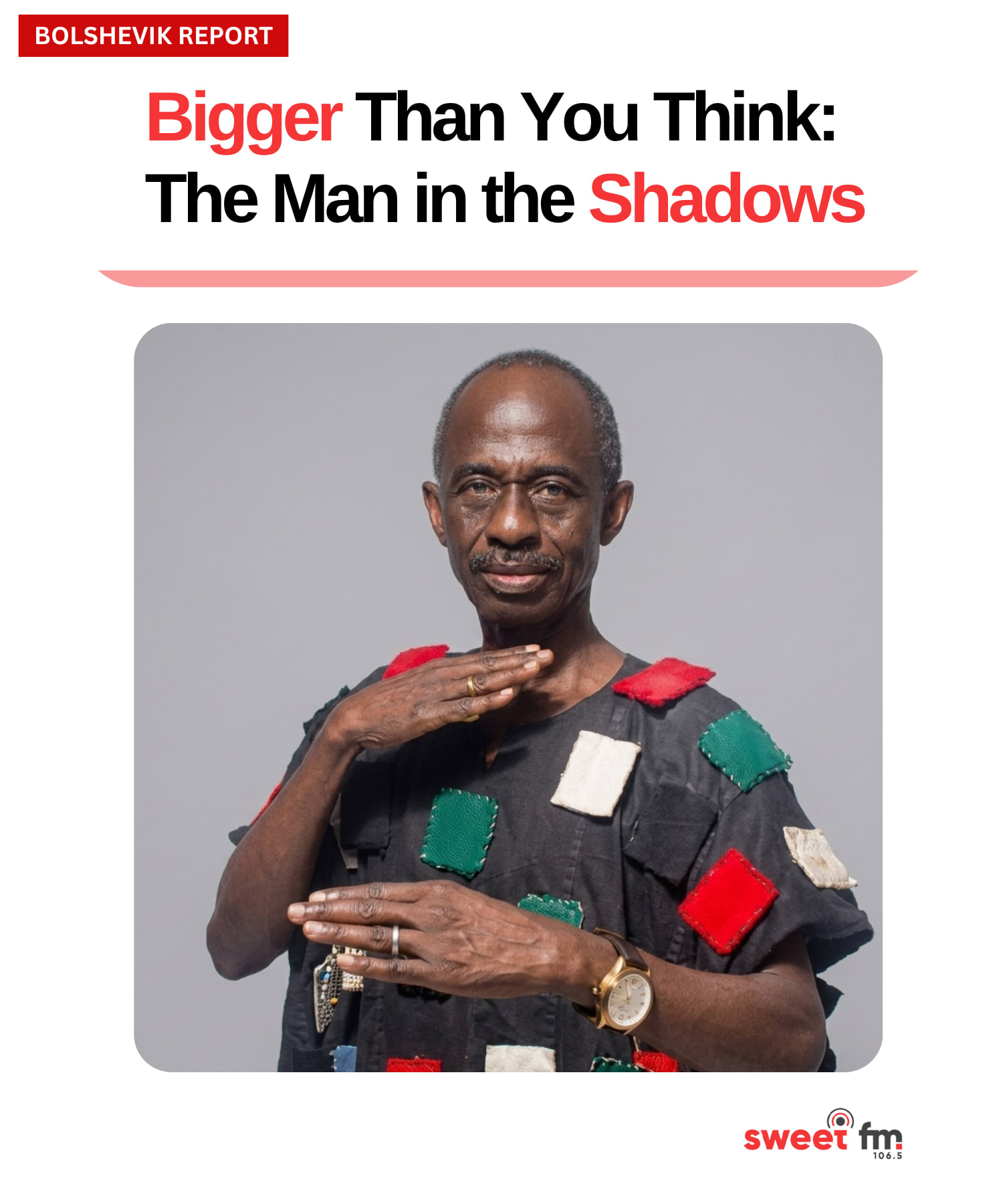
The Mosquito Who Moves Mountains
There is a particular kind of political animal that thrives not in the spotlight but in the architecture behind it — one who drafts constitutions, engineers elections, and then watches others cut the ribbon. Johnson Kwadwo Asiedu Nketiah, born Christmas Eve 1956 in Seikwa, Bono Region, to royal lineage on both sides of his family, is exactly that species. His opponents named him "General Mosquito" — a taunt meant to diminish. He wore it like armour.
The nickname, given during his parliamentary years by NPP colleagues, was a reference to his committee work — small, persistent, and capable of drawing blood. What his detractors failed to anticipate was that the mosquito, historically, has changed the course of empires. Nketiah understood the metaphor better than they did.
He trained as a teacher at St. Joseph's College of Education in Bechem. Then came the University of Ghana Business School, a BSc in Business Administration, a pioneering stint in stockbroking at the National Trust Holding Company, and eventually a Master's degree in defence and international politics from the Ghana Armed Forces Command College. The man the NPP wanted to mock as a pest had quietly assembled one of the most eclectic academic and professional portfolios in Ghanaian political life.
When the NDC needed someone to drag the party back from the wilderness of opposition in 2005, Nketiah stepped in — winning the General Secretary position with nearly 80% of delegates' votes. Three years later, the NDC was back in power. He did it again in 2024, engineering the party's second comeback after eight years out, this time from the National Chairman's seat he ascended to in December 2022.
Two comebacks. One strategist. That is not coincidence — that is craft.
The Thank-You Tour & The 2028 Question
In September 2025, Asiedu Nketiah launched what he called a "Thank You Tour" — a constituency-by-constituency sweep across Ghana's sixteen regions to express gratitude to party activists for the 2024 victory. He started in the Eastern Region, spanning 16 constituencies between 17 and 19 September. He said it was about appreciation. The political class said it was about ambition.
Both can be true. In Ghana's delegate-driven internal democracy, the man who knows every constituency chairman, who has looked every grassroots organiser in the eye, who arrives in a warlord smock and leaves behind a promise — that man holds power that no presidential appointment can manufacture. The tour was gratitude. It was also, unmistakably, a campaign.
His supporters point to a practical record: morale-boosting, activist loyalty, structural groundwork. His critics within the NDC note that the tour's nationwide ambition — all 16 regions — far exceeds what any ordinary gesture of thanks would require. In Ghanaian politics, covering the country is what presidential candidates do.
“He marched with the people in his favourite warlord smock to parliament, leading to a shake-up in the minority caucus. This move paved the way for the NDC's overwhelming victory in 2024.
— News Ghana, October 2025
Meanwhile, in June 2025, he was sworn in as Board Chairman of the Ghana Ports and Harbours Authority — a strategic appointment at the nerve centre of the country's trade infrastructure. In May 2025, he led an NDC delegation to China for party-to-party engagement with the Communist Party of China, focusing on local government reform, youth exchanges, and investment partnerships. In 2017, he was elected Vice President of the Socialist International in absentia.
Covert global influence is, it turns out, the right phrase for it. Not shadow in the conspiratorial sense — but shadow in the architectural sense. The man who holds up the building from below, invisible until the day the building stands.