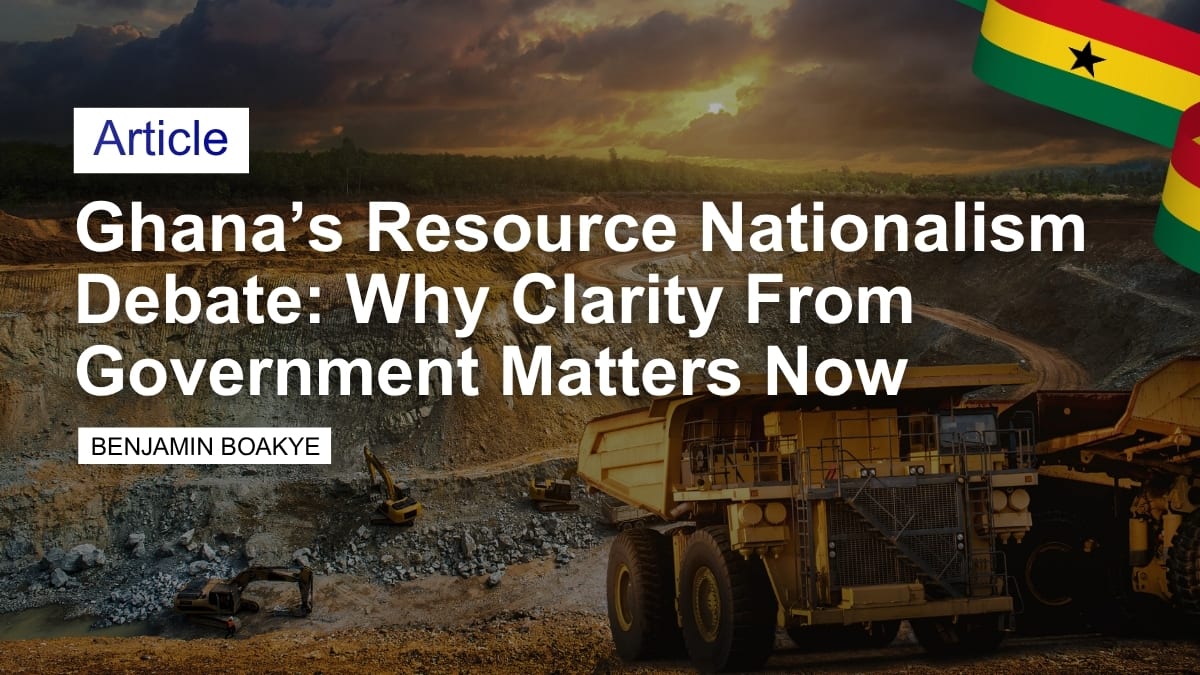
Calls for greater state control over Ghana’s mineral wealth are intensifying, but energy policy expert Benjamin Boakye has warned that ambiguity surrounding the country’s mining policy could undermine investor confidence and threaten macroeconomic stability.
According to Boakye, Ghana’s renewed debate on resource nationalism has gained momentum amid growing public concern over whether the country is receiving sufficient value from its natural resources, particularly in the mining sector.
The discussion has become more heated following calls from some influential figures advocating mine nationalisation and restrictions on lease renewals.
Boakye said the government can no longer afford to remain silent on such a critical economic issue, especially as Ghana seeks to consolidate recovery efforts after concluding its IMF-supported programme.
“At a time when Ghana is seeking a Policy Coordination Instrument with the IMF to anchor macroeconomic discipline and investor confidence, silence or ambiguity on such a consequential issue may create avoidable uncertainty within the investment community.” - Benjamin Boakye
Mining Sector Central to Economic Recovery
The policy analyst stressed that the mining industry remains one of Ghana’s most important economic pillars, contributing significantly to foreign exchange earnings, government revenues, employment and long-term investment inflows.
He cautioned that signals suggesting abrupt policy reversals or increased sovereign risk could negatively affect the country’s efforts to reduce borrowing costs and attract investment capital.
“This is not merely a sectoral discussion. It is a defining economic moment,” Boakye noted.
While acknowledging public concerns over the distribution of mineral wealth, he argued that any debate about mining reforms must be grounded in evidence rather than emotion.
“At the heart of the current debate is a legitimate question: Is Ghana obtaining sufficient value from its mineral resources?” he asked.
Boakye maintained that reviewing fiscal regimes and extractive agreements is necessary as commodity prices, technologies and development priorities evolve. However, he warned against approaches driven by “purely sentimental debate.”
Nationalisation Debate Raises Concerns
One of the most controversial proposals emerging from the public discourse is the suggestion that Ghana should nationalise mines whose leases are approaching expiration.
Boakye rejected this interpretation, arguing that it misrepresents both Ghana’s mining laws and the realities of the industry.
He recalled Ghana’s experience with extensive state control of mining operations during the 1970s, describing the outcome as economically damaging.
“The result was not the strengthening of the industry, but rather a significant decline in production, underinvestment and operational inefficiencies.” - Benjamin Boakye
According to him, Ghana was eventually forced to reopen the sector to foreign investment during the economic reforms of the 1980s and 1990s.
Boakye argued that modern mining requires sustained long-term capital, technological expertise and continuous investment in exploration, equipment and environmental management.
Without those elements, he warned, mining industries can deteriorate rapidly.
“The debate itself is healthy,” Boakye said, “but the outcome must strengthen Ghana’s competitiveness rather than weaken it.”
He therefore urged policymakers to protect the principles of contractual sanctity, regulatory predictability and investment stability while pursuing reforms that improve national benefits.
READ ALSO: Ghana's Financial Sector Assets Rise to GH¢647.25bn as Stability Returns in 2025