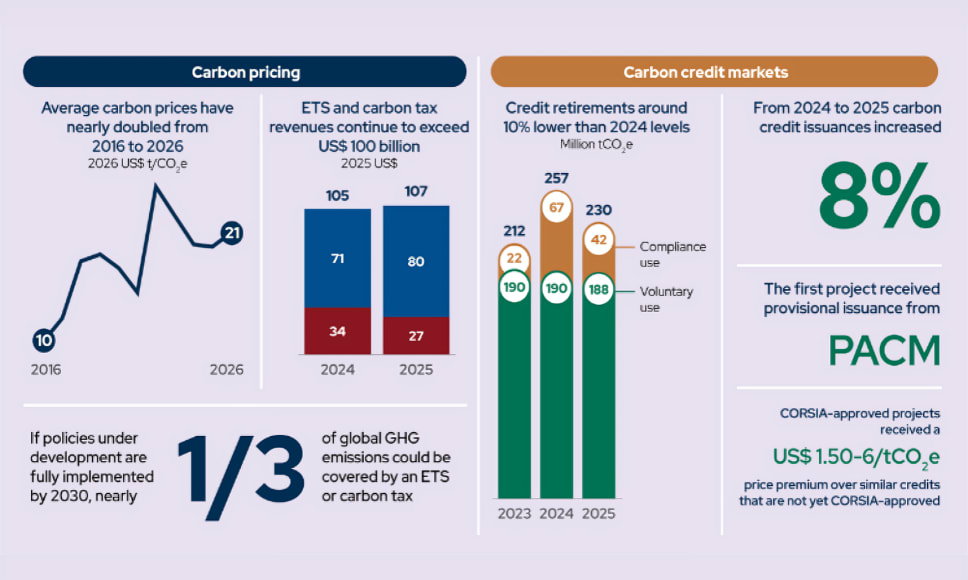
Global revenues generated from carbon pricing mechanisms exceeded $107 billion in 2025, highlighting the growing importance of emissions markets and carbon taxes in financing the global transition toward low-carbon economies.
According to the latest State and Trends of Carbon Pricing 2026 report released by the World Bank, carbon pricing instruments now cover nearly 30 per cent of global greenhouse gas emissions through 87 implemented policies worldwide.
The report noted that the revenues were raised through emissions trading systems, carbon taxes and other climate-linked pricing frameworks requiring companies to pay for their greenhouse gas emissions.
Analysts say the figures demonstrate how carbon pricing is increasingly evolving beyond an environmental policy tool into a major source of public finance, industrial transformation and green investment funding.
Carbon Pricing Expands Across Global Economies
The World Bank said global carbon pricing revenues increased by 2 per cent in 2025, reflecting sustained momentum despite fluctuations in carbon prices across major markets.
The expansion is becoming particularly visible in emerging and middle-income economies, many of which are either introducing or strengthening carbon pricing systems as part of broader climate and industrial strategies.
“All large middle-income economies have either implemented or are planning direct carbon pricing instruments,” the report stated, signalling a major shift in the geography of global climate finance.
Countries across Asia are already accelerating reforms. Japan recently launched its Green Transformation emissions trading system to support industrial decarbonisation and energy transition financing, while India and Vietnam are preparing broader carbon market frameworks expected to take effect from 2026 onward.
In Nigeria, authorities are also advancing a national carbon market framework aimed at attracting climate-linked investment and expanding participation in global carbon credit trading.
Africa Faces Opportunity and Risk
For African economies, the expansion of global carbon pricing presents both opportunity and complexity.
The continent holds significant potential in renewable energy, forest conservation, sustainable agriculture, methane reduction and clean cooking projects that could generate carbon credits for international markets.
However, experts warn that Africa’s ability to benefit meaningfully from carbon finance will depend heavily on governance standards, transparency and investor confidence.
The World Bank report revealed that global carbon credit issuances rose by 8 per cent between 2024 and 2025, although prices softened slightly during the year.
Certain high-quality projects continued to attract premium pricing, particularly forest conservation, reforestation and aviation-related carbon credits.
That trend may create challenges for countries with weak monitoring, reporting and verification systems, as global buyers increasingly prioritise high-integrity carbon credits.
Climate Finance and Fiscal Pressures
Governments are increasingly viewing carbon pricing as a potential source of fiscal revenue amid rising public spending pressures and climate financing needs.
The World Bank said revenues from carbon pricing can help finance clean energy projects, social protection programmes, industrial decarbonisation and climate adaptation initiatives when managed effectively.
But economists caution that poorly designed carbon taxes or emissions schemes could increase living costs for households and raise production expenses for energy-intensive industries.
As a result, policymakers face the challenge of balancing climate goals with economic and social stability.
For Africa, the debate goes beyond environmental policy. The central question is whether carbon markets can become a credible development finance tool capable of supporting industrialisation, job creation and long-term economic transformation.
The World Bank’s latest findings suggest carbon pricing is becoming a central pillar of the global climate-finance architecture.
However, the long-term success of these systems will ultimately depend on whether rising revenues translate into cleaner industries, stronger economies and measurable progress toward global net-zero ambitions.
READ ALSO: Johannesburg Could Face Power Cuts Over Unpaid Debt