The Ghana Gold Board (GoldBod) has called on international investors to support Ghana’s gold value chain, urging partnerships in local refining, jewellery manufacturing, responsible mining and technology transfer as the country seeks to retain more value from its mineral resources.
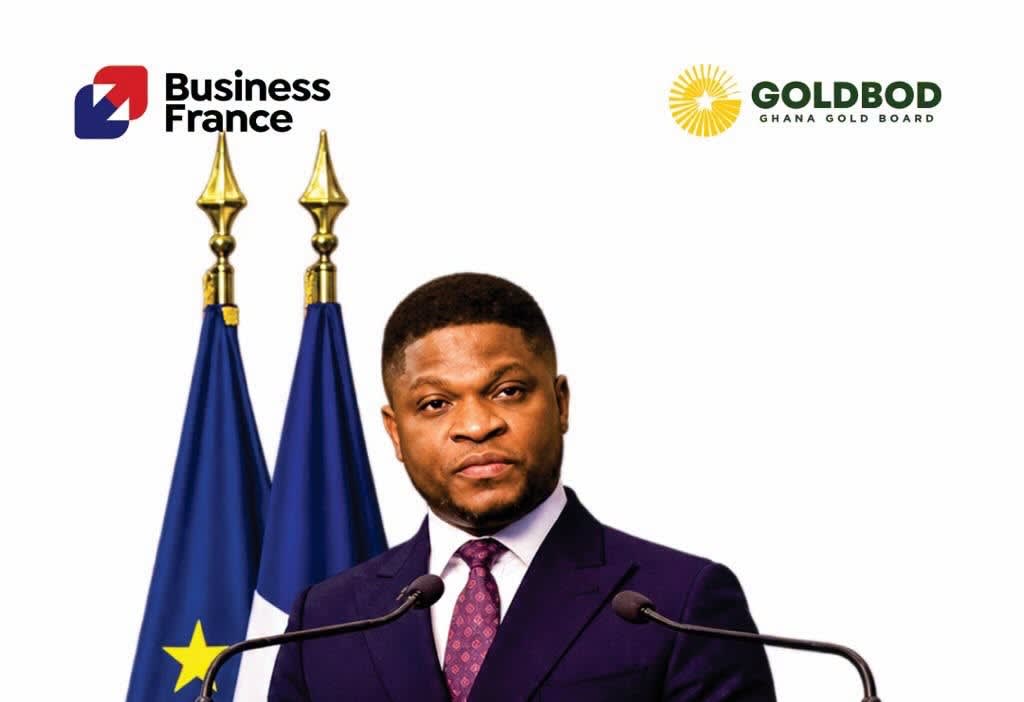
GoldBod Chief Executive Officer Sammy Gyamfi made the appeal at the Ambition Africa conference in Paris, where he outlined Ghana’s efforts to formalise artisanal and small-scale mining gold production and attract investment into downstream activities.
Speaking on the theme, Africa’s Minerals, Africa’s Future: A New Pact for Investment, Economic Transformation and Shared Prosperity, Gyamfi argued that Africa must move beyond exporting raw minerals if its natural resources are to create lasting economic opportunities.
He proposed what he described as a new partnership between African countries and global investors, built around the principle of “Fair Return for Fair Value”.
“Investors are entitled to competitive returns, and African governments must deliver the congenial atmosphere that allows investment to thrive,” he said.
However, he stressed that African countries must also benefit from the technology, processing capacity and industrial opportunities associated with their mineral resources.
Gold exports rise following GoldBod reforms
Gyamfi pointed to Ghana’s experience with the GoldBod as an example of efforts to capture more value from mineral production that previously escaped the formal economy.
He cited a SWISSAID analysis which identified a 229-tonne discrepancy in Ghana’s gold trade figures between 2019 and 2023, valued at approximately US$11.4 billion.
According to him, the establishment of GoldBod was intended to address the loss of artisanal and small-scale mining gold through smuggling by bringing more production into the formal trading system.
Official artisanal and small-scale gold exports increased from 63 tonnes in 2024 to 104 tonnes in 2025, generating approximately US$10.8 billion for Ghana, he disclosed.
Between January and October 20, 2026, a further 85.4 tonnes of gold, valued at US$11.6 billion, had been exported through the initiative.
Gyamfi described the development as a major contributor to the country's economic reset over the preceding 23 months.
He cautioned, however, against interpreting the increased exports as entirely new production.
“GoldBod did not manufacture gold that did not exist,” he said, explaining that the institution had primarily recovered production that was already taking place but was being channelled outside the formal economy.
Local refining and jewellery manufacturing push
The GoldBod CEO said Ghana was also making progress in expanding local refining capacity, disclosing that approximately 27 tonnes of artisanal and small-scale mining gold had been refined domestically in 2026.
He added that the reforms had created about 5,000 direct jobs, although he did not provide a breakdown of the employment figures.
A major part of the next phase of the initiative will be the Ghana Gold Souk, which Gyamfi said was intended to establish an industrial hub for jewellery manufacturing and fabrication.
He invited international investors to participate in the project from 2027, arguing that Ghana needed to develop industries capable of turning locally produced gold into higher-value products.
The GoldBod is also seeking investment in responsible mining, mercury-free processing, refining, fabrication and gold trading.
Gyamfi said investors could benefit from opportunities to develop businesses, transfer technical expertise and introduce technologies that would strengthen Ghana's mining and manufacturing industries.
Gold price volatility reinforces call for value addition
The appeal comes amid a decline in international gold prices, which Gyamfi said exposed the vulnerability of mineral-producing countries to fluctuations in global commodity markets.
He noted that African governments had little control over international gold prices but could determine how much economic value they retained from production. “Prices rise and fall, but capacity built at home endures,” he told participants.
For Gyamfi, expanding local processing and manufacturing is therefore not simply an industrial ambition but a way of protecting African economies against commodity price volatility.
He argued that exporting raw minerals without developing industries around them would do little to address unemployment and the limited industrial base across many African economies.
Gyamfi calls for a new Africa-Europe partnership
The GoldBod CEO also connected the investment appeal to Africa’s employment challenges, noting that between 10 million and 12 million young Africans enter the labour market annually, while only about three million formal jobs are created.
He said the continent's mineral wealth offered an opportunity to address this gap, provided governments could attract long-term investment into productive industries.
Gyamfi called for stronger economic partnerships between Africa and Europe, with European capital and technology complementing Africa’s natural resources, workforce and entrepreneurial capacity.
He argued that existing trade relationships must move beyond a model in which Africa supplies raw materials while processing, manufacturing and higher-value economic opportunities remain elsewhere.
“Partnership has two sides,” he said, adding that African countries must meet legitimate investor expectations while investors must recognise the need for economic transformation in resource-producing countries.
He urged international businesses to invest in Ghana and participate in building industries that could generate employment and expand local manufacturing.
“Let’s produce together. Let’s process together. Let’s add value together. Let’s build together. And let’s prosper together,” Gyamfi said.
His message to investors was that the success of Africa’s mineral sector should be measured not only by the volume of resources extracted or profits generated, but also by the industries, businesses, jobs and communities created from those resources.
READ ALSO: One Dead, Five Soldiers Injured in Odaw Railway Demolition