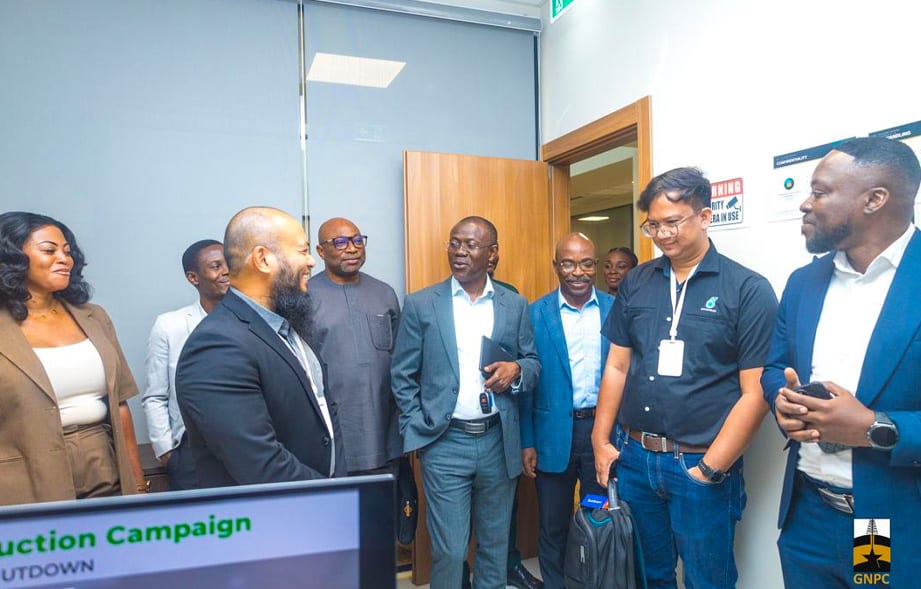
The Minerals Income Investment Fund (MIIF), together with key institutions within Ghana’s extractive sector, has revived an inter-agency committee aimed at strengthening the monitoring, verification and collection of mineral royalties and other mining-related revenues owed to the state.
The reconstituted committee brings together representatives from the Ghana Revenue Authority, Minerals Commission, Ghana Standards Authority, Minerals Development Fund, Economic and Organised Crime Office, Ghana Gold Board, Environmental Protection Authority and the Ministry of Lands and Natural Resources.
The committee is chaired by Dr. Martin Yamborigya, Acting Commissioner of the Domestic Tax Revenue Division of the GRA.
Renewed Focus on Royalty Monitoring
Discussions at the meeting centred on restoring coordination among institutions responsible for monitoring production declarations, royalties, licences and regulatory compliance across Ghana’s mining sector.
Chief Executive Officer of MIIF, Mrs. Justina Nelson, said the committee’s revival became necessary after a period of inactivity linked to institutional transitions, which created gaps in monitoring and enforcement.
She explained that the renewed platform would help tackle concerns relating to undeclared production, royalty leakages and weak oversight, particularly within parts of the small-scale mining sector.
“Mineral royalties remain a critical source of revenue for national development and infrastructure financing,” Mrs. Nelson stated, while highlighting the importance of stronger institutional cooperation.
Mrs. Nelson also referenced Ghana’s revised mineral royalty framework, which shifted from a fixed royalty regime to a sliding scale system.
According to her, the reform, combined with elevated global gold prices, is expected to improve royalty inflows significantly and strengthen state revenue mobilisation.
Dr. Yamborigya acknowledged that domestic revenue collection challenges remain, especially within quarrying, salt production and other mineral operations that often receive limited monitoring attention.
Strengthening Transparency and Accountability
Committee members reviewed draft operational guidelines covering governance structures, reporting systems and oversight mechanisms. Discussions also focused on improving inter-agency data sharing and developing a comprehensive database of mining operators and mineral rights holders.
Participants further examined funding arrangements to support field inspections and monitoring activities, including possible cost-sharing mechanisms among member institutions.
Officials from the GRA noted that previous collaborative interventions had produced positive results and expressed confidence that renewed coordination would strengthen compliance and improve revenue assurance.
At the close of the meeting, members agreed to hold regular monthly meetings to sustain engagement and improve transparency within Ghana’s extractive sector.
MIIF officials stressed that the Fund’s role would focus on coordination and secretariat support, while the broader objective remains protecting national interest and ensuring Ghana derives long-term value from its mineral resources.
READ ALSO: Calls Intensify for Petroleum Act Review to Secure Crude Supply for TOR