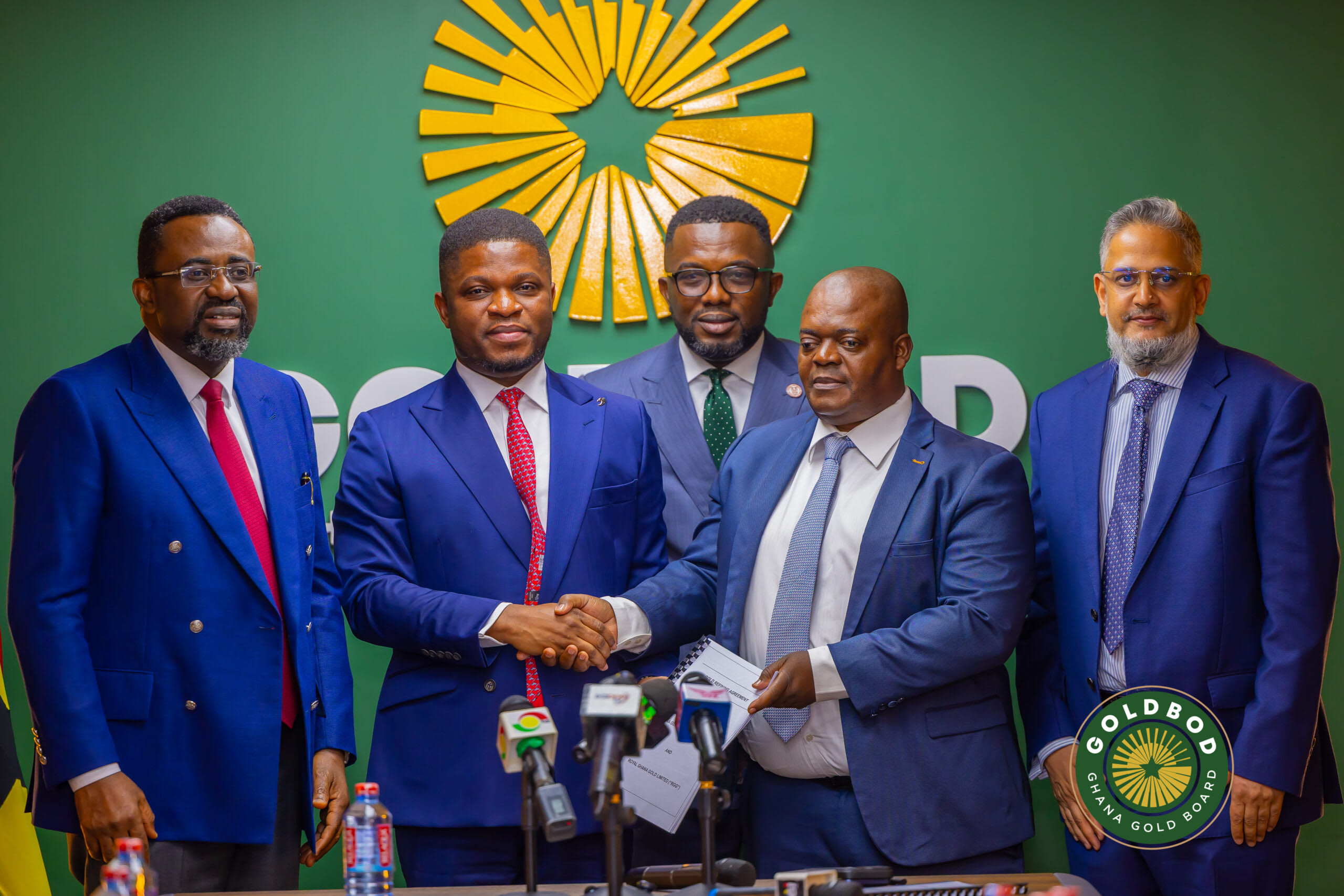
The Ghana Gold Board has signed a major gold refining agreement with Royal Ghana Gold Refinery Limited as part of efforts to deepen local value addition and strengthen Ghana’s position within the global gold industry.
Under the agreement, the GoldBod will supply up to one metric tonne of gold every week to the refinery for processing, reinforcing the government’s broader strategy to ensure more mineral value is retained within the country before export.
The agreement was signed on Monday, May 25, 2026, at the GoldBod headquarters in Accra in the presence of officials from the Bank of Ghana, directors of the GoldBod and executives of Royal Ghana Gold Refinery Limited.
GoldBod Pushes Local Refining Agenda
Addressing the signing ceremony, GoldBod Chief Executive Officer Sammy Gyamfi described the partnership as a landmark moment in Ghana’s mining sector reforms and a reflection of the industrialisation vision of John Dramani Mahama.
According to Mr. Gyamfi, the government has tasked the GoldBod with leading Ghana’s mineral value addition drive with the long-term objective of ensuring that all minerals mined in Ghana are refined locally before export by 2030.
“Our vision is to refine all the gold we purchase from the artisanal and small-scale mining sector as well as the percentage of gold we receive from the large-scale mining sector before export.” - GoldBod CEO
The agreement marks the second major refining partnership signed by the GoldBod in 2026, following an earlier deal with Gold Coast Refinery earlier this year.
Mr. Gyamfi stated that local refining would enable Ghana to retain refining fees, recover valuable by-products such as silver, increase foreign exchange earnings and create more employment opportunities for Ghanaians.
He added that the initiative would also help address purity losses associated with exporting unrefined gold.
Bank of Ghana Backs Initiative
Governor of the Bank of Ghana Johnson Asiama reaffirmed the central bank’s support for the partnership and disclosed that the Bank of Ghana holds a minority stake in Royal Ghana Gold Refinery Limited.
Dr. Asiama explained that the investment was intended to strengthen regulatory oversight while supporting Ghana’s broader strategy to maximise value from its gold resources.
He described the agreement as a strategic intervention that aligns with efforts to improve reserve accumulation and strengthen economic stability.
Chief Executive Officer of Royal Ghana Gold Refinery Limited Eric Frimpong expressed appreciation to the government, the Finance Ministry and the Bank of Ghana for their confidence in the refinery.
Mr. Frimpong said the company possesses the technical capacity, modern equipment and skilled workforce required to operate continuously and support Ghana’s industrial transformation agenda.
According to him, the refinery’s long-term ambition is to secure accreditation from the London Bullion Market Association and position Ghana competitively within the global refining industry.
He also pledged to expand refining capacity beyond the initial one metric tonne per week threshold while creating additional jobs for Ghanaians.
The agreement follows a familiarisation tour undertaken by the GoldBod leadership to the refinery’s facility in April 2026, during which the company’s infrastructure and operational readiness were assessed.
Industry analysts say the latest partnership further strengthens Ghana’s ambition to move beyond raw gold exports and develop a fully integrated gold value chain driven by local refining, responsible sourcing and industrial development.
READ ALSO: Carlos Queiroz Names Black Stars Squad for Wales Friendly and World Cup Camp