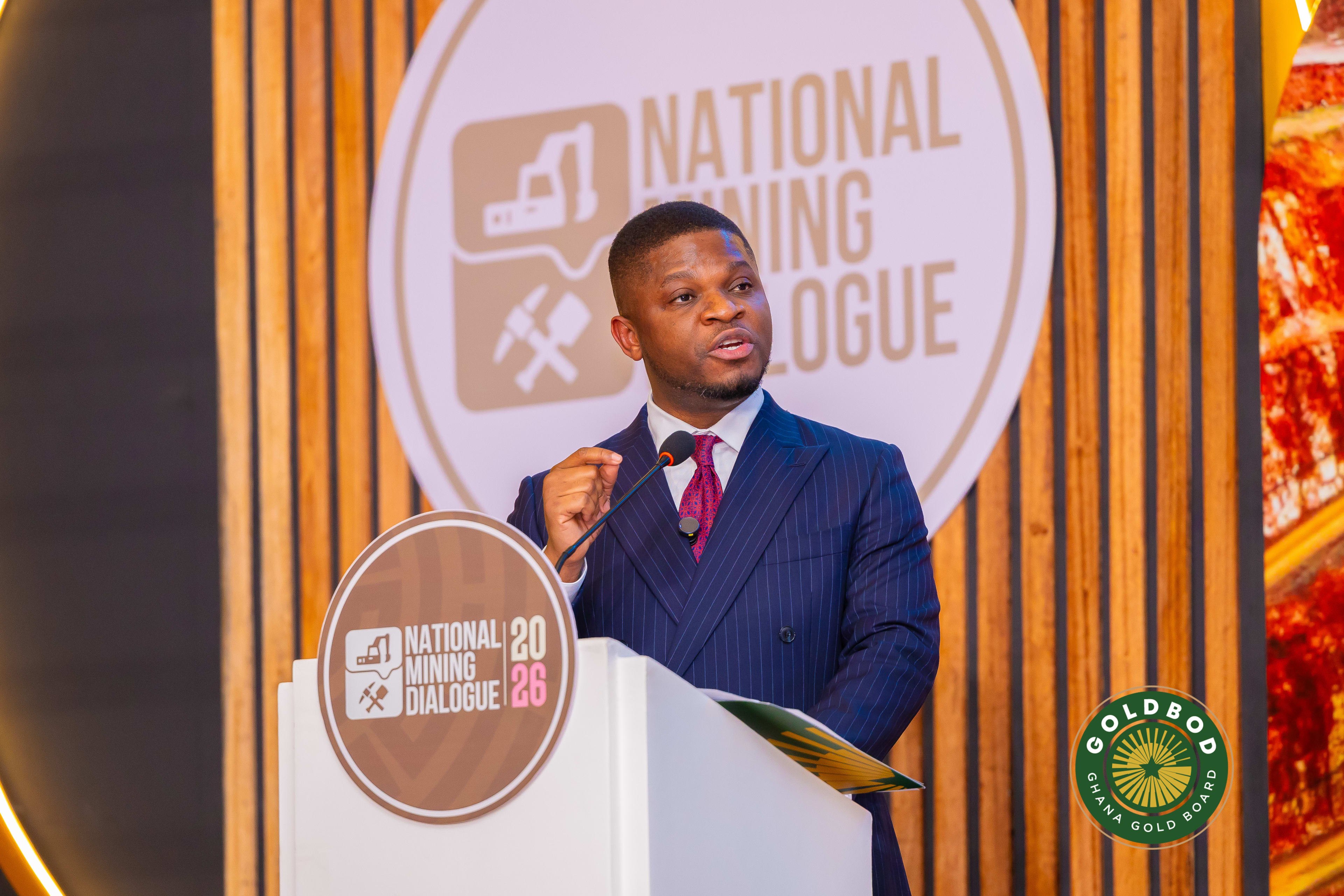
Ghana must fundamentally reset the relationship between mining companies, the state and resource rich communities if more than a century of gold extraction is to translate into broad based development.
That was the blunt assessment from the Chief Executive Officer of the Ghana Gold Board, who insists the extractive sector must completely rethink its social licence to operate.
Addressing stakeholders at the National Mining Dialogue in Accra on August 18, the GoldBod boss argued that earning public trust can no longer rely on regulatory approvals and mineral rights alone.
The industry must now be judged by local ownership, decent jobs, environmental protection and visible economic improvements across host communities.
"The theme before us, ‘Rethinking the Social Licence to Operate,’ is not just a sweet conference slogan. It is a political, economic and moral demand," he told the gathering.
"Natural resources are God’s gift to the communities that host them and a blessing to the State.
"If those resources do not transform the communities from which they are taken, then we have not fully converted blessing into development." - GoldBod CEO
The Deepening Contradiction in Mining Towns
The intervention touched a raw nerve regarding one of the most frustrating contradictions in the Ghanaian economy. The country remains one of the top gold producers on the continent and has benefited massively from stronger bullion prices and surging production.
Yet the actual mining districts remain plagued by severe youth unemployment, environmental devastation, broken roads and heavily polluted water sources.
The CEO painted a grim picture of this enduring disparity, warning that public patience is wearing dangerously thin as residents watch immense wealth leave their ancestral lands.
"We cannot continue to mine gold from the soil of our communities while poverty, lack of access to potable water, poor roads, youth unemployment and weak local economies remain the daily reality of too many mining communities in our country." - GoldBod CEO
This frustration is boiling over among the younger generation. The GoldBod chief noted that young people are increasingly tired of being labeled as troublemakers when they demand a fair share of the wealth extracted from their backyards.
"A social license cannot survive where the youth believe mining has no place for them except as casual laborers and bystanders, while others see them as troublesome agitators," he explained, demanding that operators build clear pathways into enterprise development, skills training and direct ownership.
Shifting from Land Donors to Economic Shareholders
Moving away from the traditional extractive model requires abandoning the mindset where companies simply dig out the ore, pay statutory taxes and occasionally hand out discretionary corporate social responsibility projects.
Under the new vision pitched by GoldBod, mining concessions must serve as anchor investments for broader local economic ecosystems that will outlive the lifespan of the actual deposits.
"Mining communities must no longer be treated as land donors.
"They are custodians of the resource hence must be treated as development partners and economic shareholders." - GoldBod CEO
He pointed to a massive ownership deficit particularly in the large scale sector, where Ghanaian participation in equity financing, exploration and downstream activities remains alarmingly low.
"The large scale mining sector has been largely foreign led, and too much of the value has leaked out of the country through ownership structures, financing arrangements, imported inputs, offshore services, limited beneficiation and weak local industrial linkages." - GoldBod CEO
Drawing a sharp contrast between the historic Obuasi gold mine and Johannesburg, he hammered home the reality that simply having minerals in the ground guarantees absolutely nothing.
"Mines do not build nations by accident. Nations build value through deliberate ownership, strategic partnerships, infrastructure, linkages, reinvestment and disciplined policy management." - GoldBod CEO
A Changing Production Landscape
The urgency of this debate is magnified by the sheer financial weight of gold in the national economy. Recent data presented at the dialogue showed merchandise exports hitting roughly 32 billion dollars in 2025, with gold singlehandedly bringing in 20.2 billion dollars.
This represents over 63 percent of total export earnings, making the precious metal the absolute anchor of macroeconomic stability and foreign exchange accumulation.
Yet the structure of who actually produces this wealth is undergoing a massive shift. Out of the 5.94 million ounces of gold produced in 2025, artisanal and small scale mining accounted for 3.11 million ounces.
"For the first time in over a century, artisanal and small scale miners overtook large scale producers," the CEO revealed.
"This proves that when Ghanaians become active value actors, their productivity will power national development." - GoldBod CEO
The Involve, Protect, and Expand Strategy
To operationalize this radical shift, GoldBod is pushing a new governance model built around three core pillars namely Involve, Protect, and Expand.
The first pillar demands direct community participation in mining decisions and the retention of mineral royalties at the decentralized level. The CEO argued that corporate social responsibility must evolve from random acts of charity into predictable, binding development obligations covering local businesses and infrastructure.
The second pillar places environmental survival at the absolute center of industry legitimacy. The days of treating ecological destruction as an acceptable cost of doing business are over.
"Water bodies, forests, farmlands and public health must be treated as non negotiable national assets. The social licence of mining cannot coexist with poisoned rivers and devastated forest reserves," he declared, calling for ruthless enforcement against operators who destroy the environment.
The final pillar focuses on expanding domestic capacity. It calls for aggressive Ghanaian ownership across the entire value chain, from early exploration to domestic refining and jewelry fabrication.
"If we want a new story, we must own more, refine more, process more, fabricate more and retain more," the GoldBod CEO stated.
"If we get this right, Ghana will not only produce gold. Ghana will produce prosperous mining towns, strategic industries around its minerals and deeper community trust." - GoldBod CEO
Ultimately, the true test of this proposed compact lies in its execution. Soaring export numbers mean very little if host communities remain trapped in squalor.
READ ALSO: Ghana Closes In on Five New Petroleum Agreements as Upstream Investor Confidence Rebounds