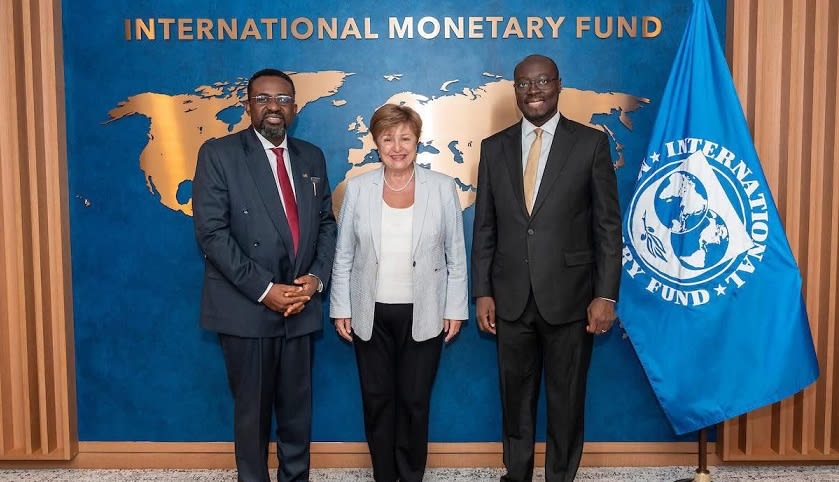
The International Monetary Fund has revised Ghana’s 2026 economic growth forecast upward to 4.8 percent, reflecting stronger-than-expected performance under ongoing reforms and improved macroeconomic stability.
The new projection marks a slight increase from the earlier 4.6 percent estimate and aligns with government targets outlined in the 2026 budget.
The revision signals growing confidence in Ghana’s economic trajectory as the country continues to implement fiscal consolidation measures.
Sources close to the Fund indicate that the adjustment is driven by “stronger-than-expected performance under the current IMF programme” and sustained commitment to fiscal discipline.
The upward revision underscores Ghana’s progress in stabilising its economy following recent challenges. Analysts point to improved revenue mobilisation, declining inflation trends, and relative currency stability as contributing factors.
The updated forecast also places Ghana among economies in sub-Saharan Africa showing signs of recovery, even as global uncertainties persist. Policymakers have maintained that disciplined fiscal management and structural reforms remain central to sustaining growth momentum.
Global Risks Weigh on Outlook
The revision comes against the backdrop of a more cautious global outlook. In its latest global assessment, the IMF downgraded world economic growth to 3.1 percent, down from 3.4 percent recorded in 2024.
According to the Fund, the downgrade is largely linked to geopolitical tensions, particularly the ongoing conflict in the Middle East, which continues to disrupt supply chains and heighten uncertainty.
The IMF warned that “the global economy faces renewed uncertainty as geopolitical tensions threaten growth and disinflation,” outlining scenarios where prolonged conflict or increased fragmentation could weaken economic performance further.
On inflation, the IMF projects that Ghana will end 2026 at 7.9 percent, slightly below the government’s target. Although inflation has eased significantly in recent months, the Fund cautions that it could rise temporarily before stabilising.
With inflation currently around 3.2 percent as of March 2026, analysts expect Ghana to maintain single-digit inflation over the medium term. The IMF further projects inflation at around 8 percent in 2027, suggesting relative price stability if current trends are sustained.
World Bank Aligns with IMF Projections
The World Bank has also projected a 4.8 percent growth rate for Ghana in 2026, reinforcing the broader consensus on the country’s economic outlook.
However, this projection reflects a slowdown compared to the estimated 6 percent growth recorded in 2025. The moderation is attributed to external pressures, including global commodity price volatility and potential spillovers from geopolitical developments.
The World Bank estimates inflation at around 9 percent by the end of 2026, slightly above government expectations but still within single-digit territory.
Despite the positive outlook, risks remain tilted to the downside. External shocks, particularly those linked to energy prices and global trade disruptions, could affect Ghana’s economic performance.
Nevertheless, the IMF’s revised growth forecast signals cautious optimism, with Ghana positioned to sustain recovery if reform efforts continue and global conditions stabilise.
READ ALSO: ECG Shake-Up Warning: Jinapor Cautions Over Poor Customer Service