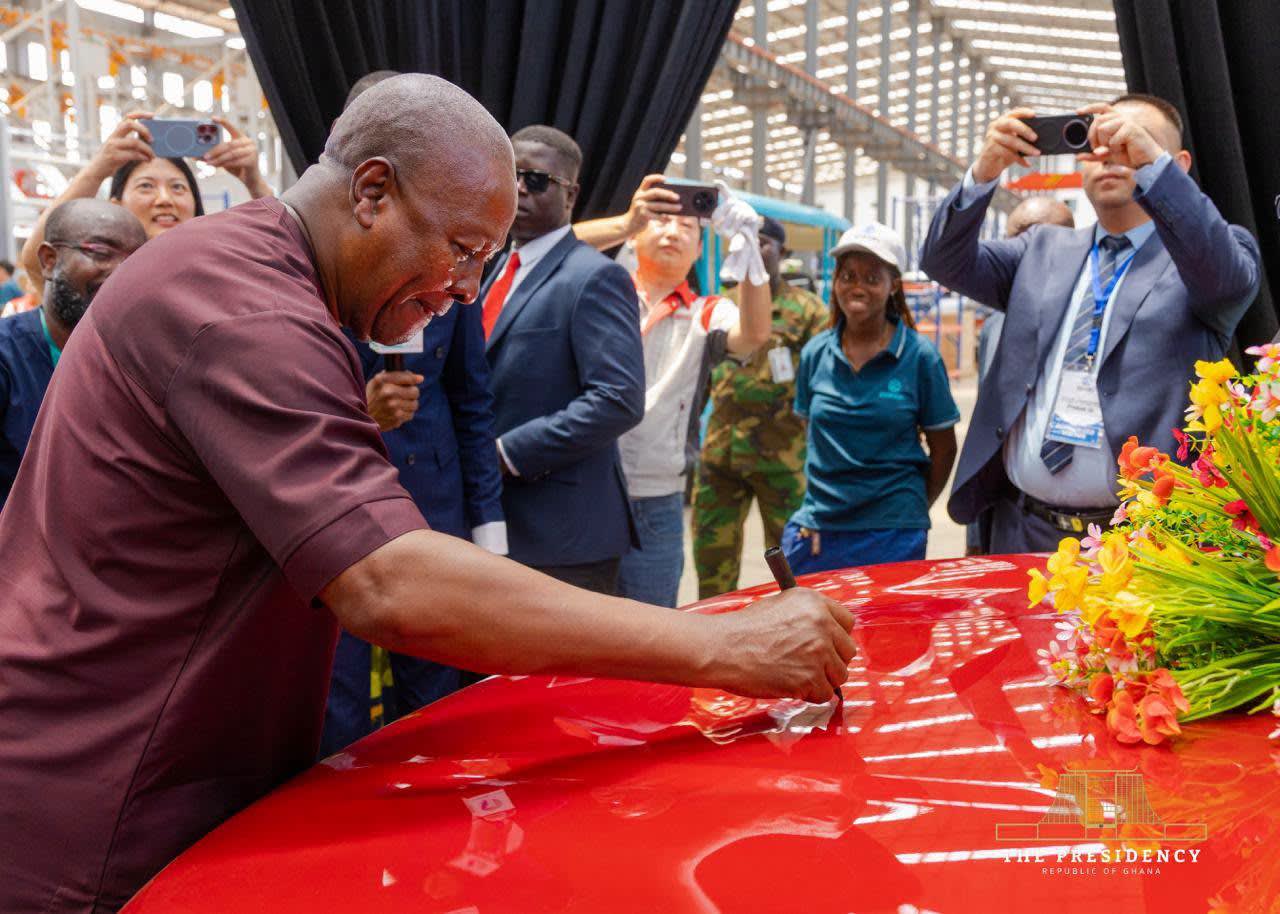
President John Dramani Mahama has commissioned the third phase of the Zonda Tec Ghana assembly plant in Tema, describing the expansion as proof that local manufacturing can play a bigger role in Ghana’s economic future.
The President said sustainable growth would depend on Ghana producing more of what it consumes and building the capacity to sell locally manufactured goods beyond its borders.
He argued that investments in vehicle assembly could reduce dependence on imports, create skilled jobs and retain more value within the country.
“Zonda Tec’s growth is itself a remarkable Ghanaian success story,” President Mahama said at the ceremony on Tuesday, September 15.
“From modest beginnings, Madam Yang Yang began as a vehicle distributor in the year 2010.
"The company she established has steadily transformed itself into Ghana’s leading assembler of heavy-duty vehicles, SUVs and small cars.” - President Mahama
From vehicle sales to assembly
Zonda Tec entered the Ghanaian market as a vehicle distributor before expanding into spare parts, after-sales services and local assembly.
The latest facility is designed to assemble sport utility vehicles, pickup trucks and electric vehicles. Company figures cited at the commissioning place its minimum annual capacity at 12,000 vehicles, with more than 800 Ghanaians employed directly.
“The plant’s minimum annual capacity is 12,000 units,” Chief Executive Officer Yang Yang said.
The figure differs from an estimate of approximately 3,000 heavy and light vehicles given in remarks by Trade, Agribusiness and Industry Minister Elizabeth Ofosu-Adjare. Further clarification may be required on whether the lower number refers specifically to additional capacity created by the third phase rather than the plant’s total annual output.
Government pushes local components
Madam Ofosu-Adjare said the expansion fits Ghana’s plan to become a credible automotive production base in West Africa.
The government is also moving beyond vehicle assembly. Its automotive component policy is intended to attract companies that manufacture parts for local plants and the replacement-parts market.
Ghana’s Automotive Development Policy aims to establish domestic assembly and manufacturing capacity through private investment and supporting regulation.
Local component production is the harder step. Assembly plants can still depend heavily on imported kits, limiting how much value remains in Ghana. Producing components locally would create a wider supply chain involving manufacturers, engineers, logistics companies and technical workers.
President Mahama said private investors would require a stable business environment and clear industrial policies if that transition is to happen.
Zonda Tec promises deeper investment
Madam Yang Yang said Ghana had grown from a commercial destination into a country the company regarded as its second home.
“Today, Ghana is no longer simply a country where we do business.
“It has become a place we believe in, a place we love and a place we proudly call our second home.” - Madam Yang Yang
She said that confidence influenced Zonda Tec’s decision to move from trading vehicles into local production.
“We want to invest here, we want to create jobs here, we want to train people here,” she said. “And most importantly, we want more value to stay here in Ghana.”
The factory’s expansion gives that ambition a physical address. The next measure will be how many vehicles actually leave the production line, how much of each vehicle is made locally and how many Ghanaian businesses find a place in the supply chain.
READ ALSO: Rice and Sorghum Prices Drop in Ghana Amid Mixed Regional Trends — AGRA Report