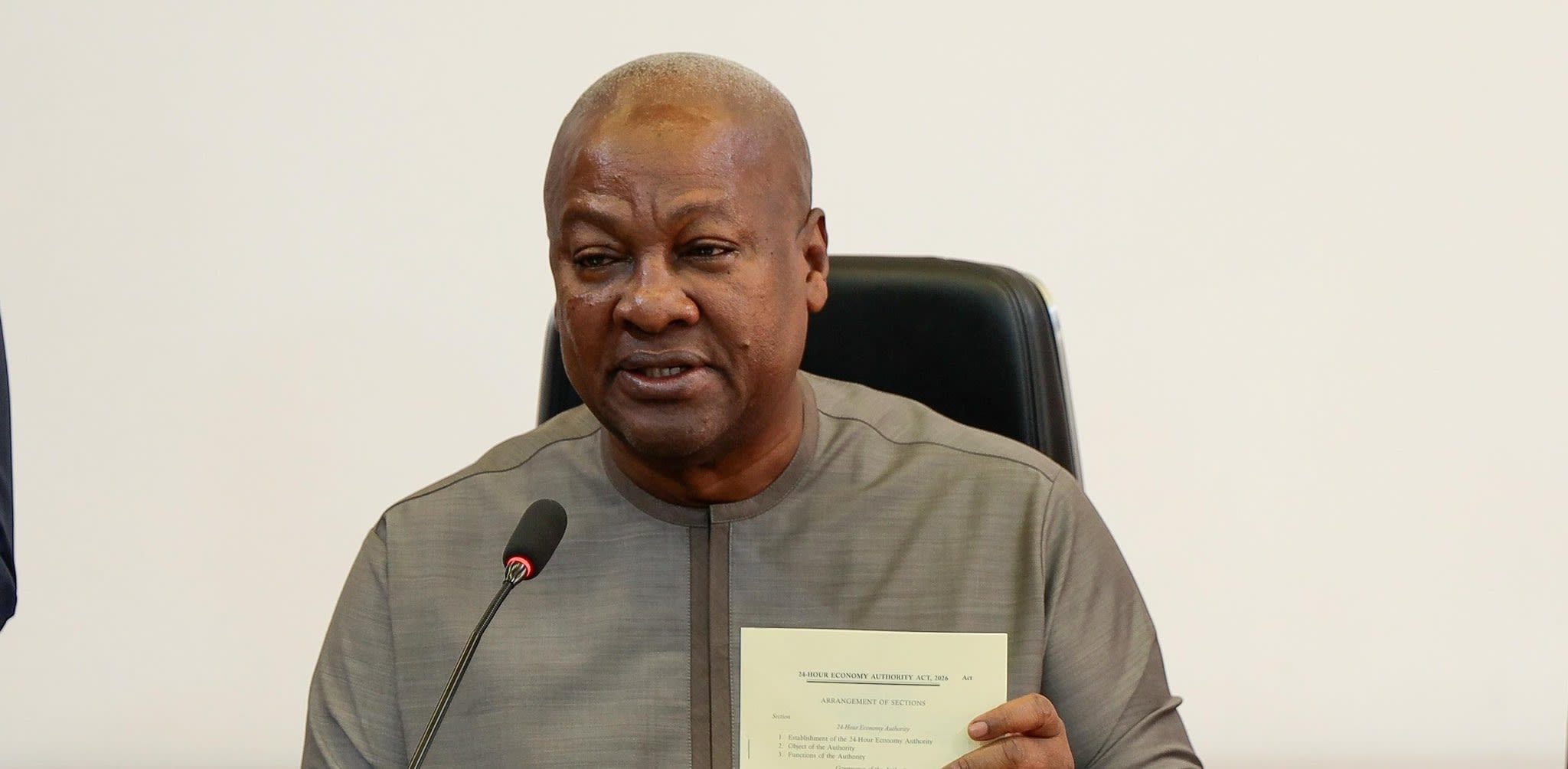
President John Dramani Mahama has signed the 24-Hour Economy Authority Bill, 2025 into law, formally launching implementation of one of the government’s most ambitious economic policies designed to expand productivity, create jobs, and attract investment.
The assent was granted during a ceremony at Jubilee House shortly before a Cabinet meeting, marking the transition of the proposal from campaign promise to active national policy framework.
“This signals that Ghana is ready for business around the clock,” officials said during the signing, describing the initiative as a catalyst for economic transformation.
The legislation had been passed by Parliament on February 6 after extensive debate between Majority and Minority lawmakers. Critics had raised concerns about implementation risks and possible duplication of existing institutional roles, while government representatives argued that the policy could significantly boost employment and productivity.
Policy Vision
The 24-hour economy concept is built around the idea of continuous productivity across sectors, encouraging businesses, factories, transport services, and public institutions to operate in multiple shifts rather than a single daytime cycle. Policymakers believe this could increase national output without requiring large new infrastructure investments.
Supporters say the policy could transform sectors such as:
manufacturing
logistics
healthcare
retail
digital services
by maximizing the use of existing facilities.
“A structured, round-the-clock economy can unlock idle capacity and create employment without waiting years for new projects,” an economist said.
Analysts say the initiative reflects a broader strategy to accelerate growth while addressing unemployment, particularly among youth.
Investor Signal
Government officials framed the law as a message to both domestic and international investors that Ghana is positioning itself as a competitive destination for business activity.
“The policy is intended to show that Ghana is open to investment and ready to expand economic opportunity,” a senior policy adviser noted.
Economists say such signals matter because investor confidence is heavily influenced by perceptions of policy direction and political commitment to growth.
Implementation Challenges
Despite optimism, experts say the success of the programme will depend on execution. Critical factors include:
reliable electricity supply
transport availability at night
security infrastructure
labour regulations
incentives for private firms
Without these supporting systems, analysts warn, businesses may hesitate to adopt round-the-clock operations.
“Passing a law is the first step. Implementation is where economic impact is determined,” a policy analyst said.
Labour unions are also expected to watch closely to ensure worker rights and safety standards are maintained if companies shift to overnight operations.
Economic Context
The new law comes at a time when Ghana is working to stabilize its economy following recent fiscal pressures. Authorities are pursuing reforms aimed at improving productivity, strengthening revenue generation, and restoring investor confidence.
Economists say policies that expand output without sharply increasing public spending are especially attractive under current conditions.
Regional Competition Factor
The timing of the initiative is also significant because regional competition for investment is intensifying. Business groups have warned that Ghana risks losing billions in economic value and hundreds of thousands of jobs if neighboring countries succeed in attracting factories and capital away from the country.
Analysts say a 24-hour production model could help Ghana remain competitive by improving efficiency and reducing operational bottlenecks.
“Countries that maximize productivity tend to attract more investment,” an industry strategist explained.
Outlook
The next phase will involve setting up the 24-Hour Economy Authority and issuing operational guidelines for businesses and public institutions. Officials say stakeholder consultations will continue as implementation begins.
Economic observers say the law’s success will ultimately be judged by measurable outcomes such as job creation, industrial output, and foreign investment inflows.
“If implemented effectively, this policy could redefine how Ghana’s economy operates,” the economist added.
For now, the signing of the bill marks a decisive step in the government’s attempt to accelerate growth and reposition Ghana as a high-productivity economy within West Africa.