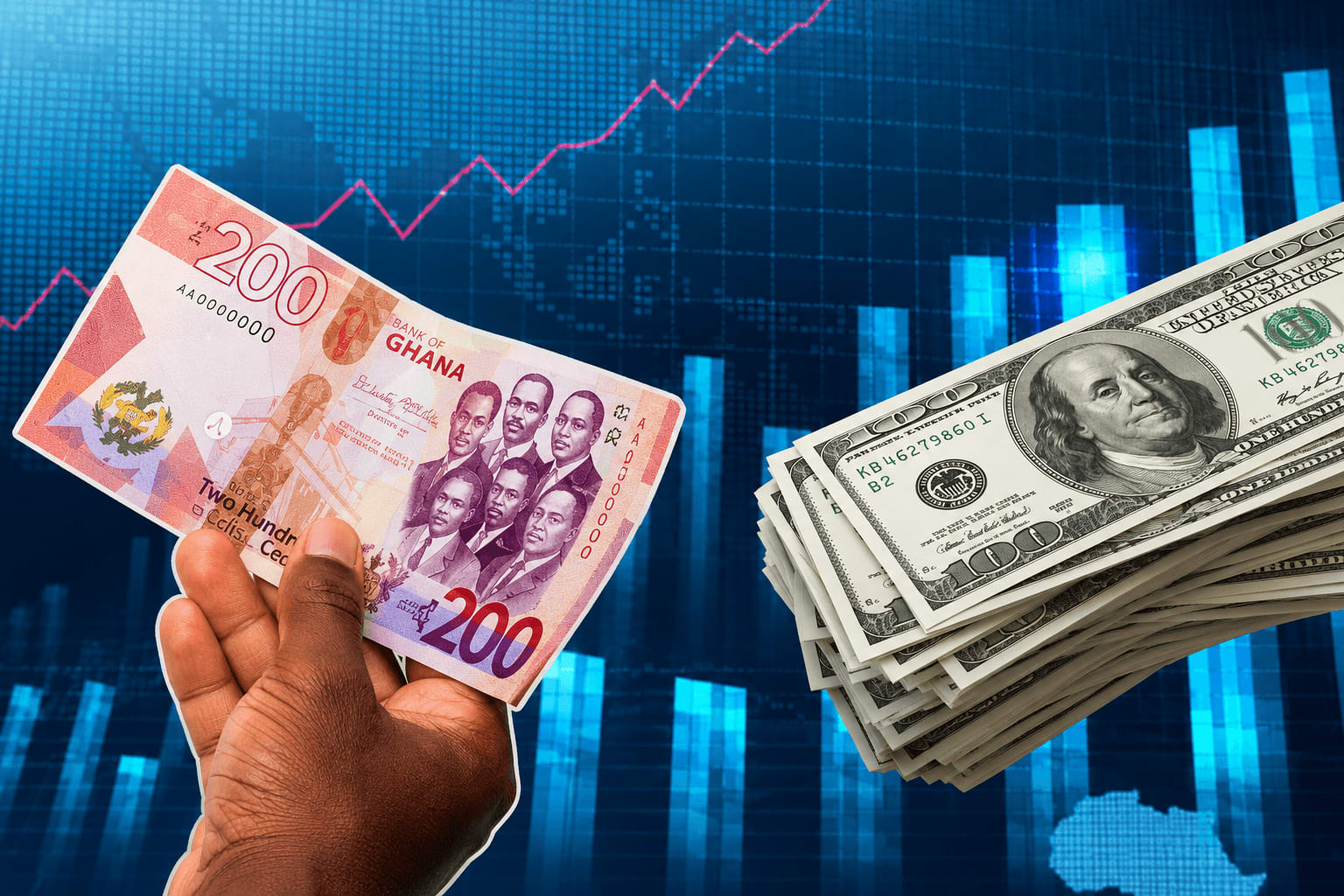
The Ghana cedi depreciation widened in July 2026, with the local currency trading at GH¢11.55 to the US dollar despite a sizeable trade surplus, strong export earnings and gross international reserves covering five months of imports.
The Bank of Ghana’s latest Summary of Economic and Financial Data, released on July 21, shows that the cedi had lost 9.50 per cent against the dollar since the beginning of the year. That compares with a year-to-date depreciation of 7.90 per cent in June.
The central bank noted that “all exchange rates are mid-rates”, with the latest observation taken on Friday, July 17.
Pressure was not limited to the dollar. The cedi also depreciated by 9.50 per cent against the British pound and 7.10 per cent against the euro. The pound traded at GH¢15.53, while the euro reached GH¢13.21.
The July position marks a clear reversal from 2025, when the cedi ended the year with a reported appreciation of 40.70 per cent against the dollar.
The dollar rate has since moved from GH¢10.45 in December 2025 to GH¢11.55 in July 2026.
It has not been a straight slide. The currency opened the year at GH¢10.95, strengthened to GH¢10.69 in February and then weakened to GH¢11.00 in March. It moved to GH¢11.19 in April, slipped sharply to GH¢11.73 in May, recovered to GH¢11.35 in June and weakened again in July.
That movement suggests a market still reacting heavily to short-term foreign exchange supply, corporate demand and sentiment. The cedi is not collapsing, but it is clearly not settled either.
Strong External Accounts Fail to Calm Market
Ghana’s external position looks supportive at first glance.
Total exports reached US$18.29 billion by June, compared with imports of US$9.48 billion. That produced a trade surplus of US$8.81 billion, equivalent to 6.60 per cent of gross domestic product.
The current account surplus stood at US$5.10 billion, while gross international reserves were reported at US$12.94 billion.
Gold remained the country’s main foreign exchange earner, contributing US$12.50 billion. Cocoa generated US$2.29 billion, with crude oil exports bringing in US$1.71 billion.
Yet strong export numbers do not mean every dollar earned reaches the foreign exchange market at the right time. Import payments, debt servicing, portfolio outflows, corporate repatriation and central bank interventions can quickly absorb available supply.
Reserves may inspire confidence. Daily demand still sets the tone.
Oil Prices Add to Foreign Exchange Demand
The commodity picture is also less comfortable than the trade surplus suggests.
Brent crude averaged US$84.10 per barrel in June, up 36.50 per cent since the beginning of the year. Realised Brent prices averaged US$87.20, representing a 45.20 per cent rise.
Higher oil prices increase Ghana’s import bill and push fuel importers to demand more foreign currency. Oil imports had already reached US$3.35 billion by June.
Gold prices remained elevated, but the average international price eased to US$4,239.90 per fine ounce. Cocoa prices were weaker, falling 27.60 per cent year to date to US$4,271.90 per tonne.
Ghana is therefore benefiting from strong gold earnings while absorbing higher oil costs and weaker cocoa prices. That is hardly a clean win for the cedi.
Businesses Face Rising Replacement Costs
For importers and manufacturers, the renewed depreciation means higher replacement costs for goods, machinery and raw materials. Fuel importers face the combined pressure of a weaker currency and rising international oil prices.
Consumers may eventually feel the impact through fuel, medicines, spare parts, transport fares and imported food products.
Inflation rose to 5.30 per cent in June, from 3.70 per cent in May, with non-food inflation at 6.30 per cent. A sustained currency slide could complicate the Bank of Ghana’s inflation outlook, even with the policy rate held at 14 per cent.
The July data leaves policymakers with an awkward reality. Ghana has stronger reserves, a large trade surplus and a positive current account, yet market confidence remains fragile.
A trade surplus can support the currency. It cannot force businesses, investors and households to stop buying dollars.
The next few months will show whether the July weakness was another temporary swing or the beginning of a more difficult phase for the cedi.
READ ALSO: Ghana's International Reserves Fall to US$12.94 Billion Despite Strong Trade Surplus