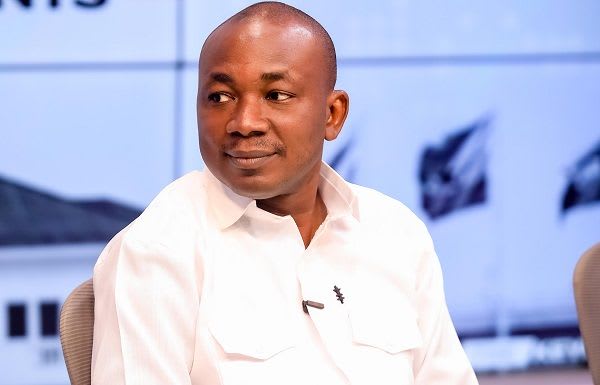
Economist and political risk specialist Dr Theo Acheampong says Ghana's inflation could remain below 10 per cent over the next three to four years if the government maintains the economic conditions underpinning its medium term projections.
The outlook, he said, is contained in the government’s medium term fiscal framework and could provide households and businesses with greater certainty after years of sharp price increases.
“The forward projection for prices going forward into the next three to four years in the medium term budget is all within the sub 10%,” Dr Acheampong said.
But he cautioned against treating lower inflation as proof that workers will automatically become better off. What matters, he argues, is how salaries move against prices and whether the economy can generate productivity, jobs and stronger incomes.
Lower inflation changes the wage conversation
Dr Acheampong said the value of a salary adjustment cannot be judged by the percentage increase alone.
A worker receiving a large pay rise during a period of rapidly rising prices can still lose purchasing power, while a smaller adjustment under stable economic conditions may retain more value.
“If you can get all these things working right, and things are stable, even if you offer workers 5% in a stable environment, it is always going to be better than offering them 30% when you have runaway inflation.” - Dr Acheampong
That comparison, however, does not mean a 5 per cent increase will always leave workers better off.
If inflation is running at 8 per cent and salaries rise by only 5 per cent, workers would still face a decline in real purchasing power. Lower inflation slows the erosion of incomes, but pay increases must still be assessed against actual changes in the cost of living.
For households, that distinction matters more than the headline number attached to salary negotiations.
Stable prices can make food, transport, rent and other expenses easier to plan for. They do not remove those expenses or automatically restore purchasing power lost during earlier periods of high inflation.
Living standards remain the real test
Dr Acheampong said economic recovery should eventually show up in the daily lives of Ghanaians.
“We also recognise really that at the end of the day, what you want is a durable improvement in living standards,” he said.
That improvement goes beyond salaries.
Employment opportunities, reliable public transport, affordable services and stronger productivity all affect how far household incomes can stretch.
A worker may receive a wage increase but still feel financially squeezed if transport, housing or essential services remain expensive.
This is why Dr Acheampong sees price stability as only one part of the recovery story.
A sustained period of single digit inflation would protect incomes better than the high inflation environment Ghana experienced during the economic crisis, but the country would still need stronger productive activity to create better paid jobs and support lasting wage growth.
Wage bill puts pressure on government spending
The debate becomes more difficult when public sector wages are placed against the government’s wider spending obligations.
Dr Acheampong said employee compensation has accounted for between 25 per cent and roughly 35 to 36 per cent of total government expenditure since 2008, averaging around 30 per cent.
He said Ghana’s wage bill also appears high when compared with some countries in the subregion.
“But when you compare Ghana’s wage bill to some of our peers, even within the subregion, you can see that the wage bill is quite extraordinarily high.” - Dr Acheampong
The pressure is not caused by salaries alone.
Government must also meet interest payments and statutory transfers, leaving a smaller share of available resources for roads, energy projects, schools, hospitals and other investments capable of expanding future economic activity.
“There’s actually nothing left to pay for capital expenditure,” Dr Acheampong said, describing the effect of the state’s major recurrent commitments.
2027 Budget faces difficult balancing act
The 2027 Budget is expected to provide a clearer picture of how government intends to manage that trade off.
It will have to balance demands for fair public sector compensation with the need to preserve enough fiscal space for investment, while keeping inflation and other macroeconomic indicators under control.
The government’s medium term inflation projections are not guaranteed. Exchange rate pressures, commodity prices, domestic supply constraints and fiscal slippages could still push prices away from the projected path.
Productivity will therefore be critical.
Lower inflation can protect the value of income, but it cannot by itself make businesses more competitive, expand output or create higher paying jobs. Sustainable wage growth ultimately depends on an economy producing more value from its workers, capital and technology.
For Dr Acheampong, that is where the next phase of Ghana’s recovery will be judged.
If inflation remains in single digits, workers may gain a more predictable environment for wages and household spending. But the more important question is whether that stability eventually produces better jobs, stronger real incomes and enough public investment to improve living standards.
The 2027 Budget will offer the next indication of whether government can connect those pieces without losing the stability already achieved.
READ ALSO: Afenyo-Markin Slams Speaker Over Abu Jinapor Removal from Chamber