Ghana oil production reached a cumulative 694 million barrels between 2010 and 2025, marking a major upstream milestone even as ageing fields and weaker drilling activity continue to drag annual output lower.
Figures contained in the Ghana National Petroleum Corporation’s 2025 annual report show that crude oil and condensate production from Greater Jubilee, Tweneboa Enyenra Ntomme and Sankofa Gye Nyame rose sharply during the industry’s first decade before entering a sustained decline after 2019.
The production story is no longer simply about how much oil Ghana has lifted. It is increasingly about what comes next.
Annual output grew from just 1.18 million barrels in 2010, when Jubilee delivered Ghana’s first commercial oil, to a record 71.44 million barrels in 2019. By 2025, however, production had fallen to 37.30 million barrels, almost half the level recorded at the peak.
GNPC attributed the slowdown to reservoir maturity, pressure depletion, increasing water cut, scaling problems, reduced drilling and periodic maintenance shutdowns.
Jubilee remains the backbone
Greater Jubilee remains Ghana’s most important producing asset. The field delivered 454.84 million barrels from first oil in December 2010 to the end of 2025, accounting for nearly two thirds of cumulative national production.
Jubilee produced 22.21 million barrels in 2025, equivalent to an average of 60,854 barrels per day. That was still well ahead of the other producing fields, but the performance also underlined Ghana’s heavy dependence on one offshore asset.
The annual report describes Jubilee’s start-up as the “historic achievement of First Oil”, an event that changed Ghana’s fiscal and energy landscape almost overnight.
TEN, which began production in August 2016, has contributed 129.37 million barrels. Its annual output fell to 5.83 million barrels in 2025, with declining reservoir pressure, especially at Enyenra, weighing on production.
Sankofa Gye Nyame offered a brighter spot. The field produced 9.30 million barrels of crude oil and condensate in 2025, beating its target by 3.84 per cent. Its cumulative production since May 2017 reached 109.78 million barrels.
Still, SGN’s stronger year was not enough to reverse the national decline.
Gas cushions GNPC’s revenue
Falling crude production and softer international oil prices affected GNPC’s earnings in 2025. Crude oil revenue declined by 5.08 per cent, from US$526.13 million in 2024 to US$499.42 million.
Natural gas changed the picture.
GNPC’s gas revenue increased by 7.67 per cent to US$952.38 million, representing 65.6 per cent of the corporation’s standalone revenue. Gas accounted for 62.7 per cent a year earlier.
The growth lifted GNPC’s total standalone revenue by 2.92 per cent to US$1.45 billion, despite the weaker contribution from crude oil.
That shift is significant. Ghana’s national oil company is increasingly being supported by a gas business that was once treated as a secondary part of the petroleum industry.
Gas production climbed from 1,443.62 million standard cubic feet in 2010 to 273,780.36 million standard cubic feet in 2025. Gas supplied from offshore fields reached a record 122,717.42 million standard cubic feet during the year, with SGN accounting for 71 per cent.
Much of that supply went to domestic thermal power plants. It helped reduce the use of imported liquid fuels while supporting electricity generation and industrial activity, including operations within the Tema Industrial Enclave.
Petroleum money reaches communities
GNPC committed US$6.57 million to corporate social investment programmes in 2025 through the GNPC Foundation.
The corporation financed tuition for more than 2,649 undergraduate and postgraduate students. It also recorded the graduation of 158 Ghanaian medical scholars trained in Cuba.
Classroom blocks, science laboratories and student hostels were handed over during the year. GNPC also completed six sanitation facilities, nine community boreholes and three artificial football pitches in selected communities.
Its Coast to Coast programme engaged more than 70 fishing communities. The exercise was intended to build a database capturing the social and economic conditions of people living along Ghana’s coastline, where offshore petroleum activity intersects directly with fishing livelihoods.
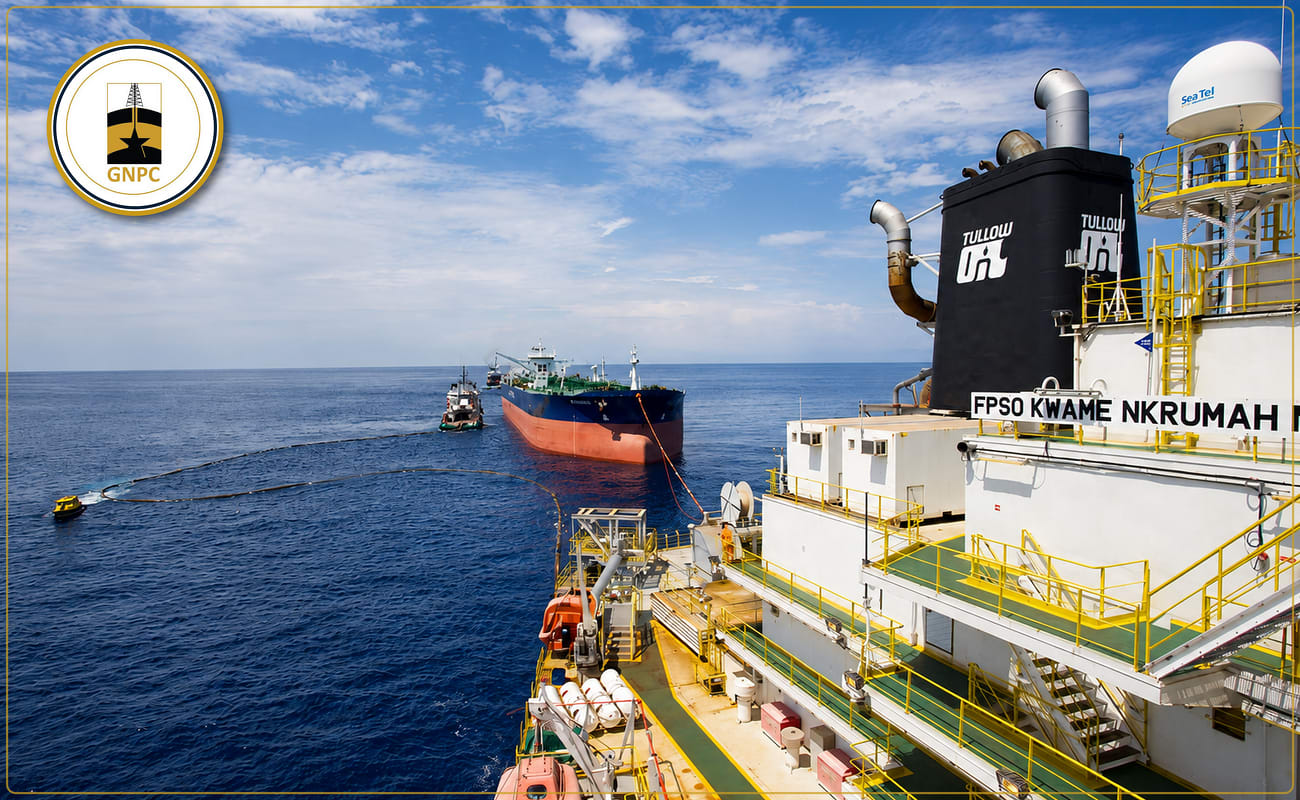
Operational work on the country’s floating production vessels helped reduce gas flaring across the three producing fields.
Repairs and equipment replacements on FPSO Atta Mills and FPSO Kwame Nkrumah contributed to a 30.28 per cent reduction in flaring. Volumes declined from 30.53 billion standard cubic feet in 2024 to 21.28 billion standard cubic feet in 2025.
GNPC has set a target of achieving “zero routine flaring by 2030”. The latest reduction moves the industry closer, although more than 21 billion standard cubic feet of gas was still flared during the year.
Search for the next production cycle
Reversing Ghana’s oil decline will require new wells, fresh discoveries and faster development of resources that have remained underground for years.
GNPC and its partners have secured extensions of the Deepwater Tano petroleum agreements covering Jubilee and TEN to December 2040. The extension provides a longer investment window for additional drilling and reservoir work.
The Eban Akoma discoveries on the Cape Three Points Block 4 have also been declared commercial. The discoveries could add about 15.8 million barrels through a phased subsea connection to existing SGN infrastructure.
Attention is also turning inland. GNPC plans to drill the first exploratory well under the Voltaian Basin Project in the fourth quarter of 2026. It would be Ghana’s first onshore exploration well in more than five decades.
Marginal offshore discoveries are being considered through the proposed Tano Atlantic and Greater Central production clusters.
After 694 million barrels, Ghana has proved it can produce oil. The harder task now is replacing what has already been extracted before the decline becomes steeper and more expensive to reverse.
READ ALSO: BOSTenergies Engages Tanker Drivers, Three-Day Strike Suspended Over Kumasi Depot Concerns