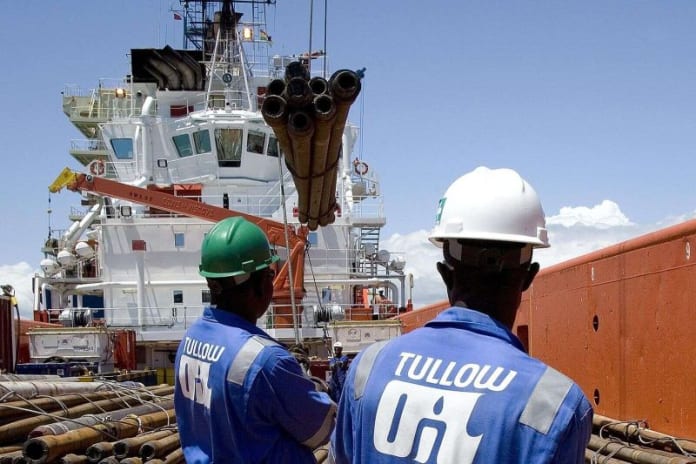
Tullow Oil committed about 97% of its first-half capital expenditure to Ghana, underlining how deeply the company’s future is now tied to the Jubilee and TEN offshore fields.
The London-listed producer spent approximately US$130 million of its US$134 million group capital expenditure in Ghana during the six months to June 2026, focusing largely on drilling, production optimisation and extending the commercial life of its offshore assets.
The scale of Tullow Ghana capital spending leaves the company increasingly exposed to reservoir performance, operational reliability, government policy and the timely payment of gas obligations in Ghana.
Jubilee Delivers Above Expectations
Gross production from Jubilee averaged 70,800 barrels per day during the first half, above Tullow’s expectations. The company’s net entitlement was 27,600 barrels per day.
The field’s floating production, storage and offloading vessel also recorded uptime above 99%, reflecting improvements following maintenance and reliability work during the 2025 shutdown.
Six new production wells from the 2025 and 2026 drilling campaign supported output, while production optimisation measures, including gas lift and dual-riser operations, helped reduce decline rates from existing wells.
TEN remained smaller, producing 14,800 barrels per day gross, with Tullow’s net share at 8,100 barrels per day. Still, the field performed above expectations and could play a larger role as Tullow integrates its Ghanaian operations.
Ghana to Take Nearly All 2026 Investment
Tullow expects full-year capital expenditure of around US$200 million, with about US$195 million earmarked for Ghana.
Of that amount, approximately US$185 million is expected to go into Jubilee, including close to US$150 million for drilling.
The company has also signed a rig contract covering up to 10 wells under a new 2027 and 2028 drilling programme, with the rig expected to arrive around the middle of next year.
Targets will be selected using 4D seismic data and information from an Ocean Bottom Node survey, aimed at improving subsurface understanding and reducing drilling risk.
The extension of the West Cape Three Points and Deepwater Tano petroleum agreements to 2040 has materially changed Tullow’s reserve outlook.
The company’s proved and probable reserves increased from 100.2 million barrels of oil equivalent at the end of 2025 to 121.7 million barrels by June 2026.
Tullow reported a reserve replacement ratio of around 380%, although the increase reflected a combination of longer licence tenure, improved well performance and maturation of existing projects rather than a single new discovery.
Ghana Clears Historic Gas Receivables
Cash flow from Ghana has also improved.
Tullow recovered US$73 million in historic gas receivables from the Government of Ghana during the first half, with the company reporting that the remaining old balance had been paid by September 28. It also received US$23 million for gas supplied in 2026.
The payments matter because Tullow ended June with group net debt of US$1.398 billion. Ghana’s offshore assets must therefore generate enough cash to fund operations, drilling, taxes and debt service at the same time.
For Ghana, the investment presents another question beyond headline capital spending: how much of that money is captured by local suppliers, workers and technical service companies.
With almost Tullow’s entire investment budget now concentrated in Ghana, the performance of Jubilee and TEN has become central not only to the company’s balance sheet, but also to the wider economics of Ghana’s upstream petroleum industry.
READ ALSO: BoG Clarifies GoldBod Board Role, Names Matilda Asante-Asiedu as Representative