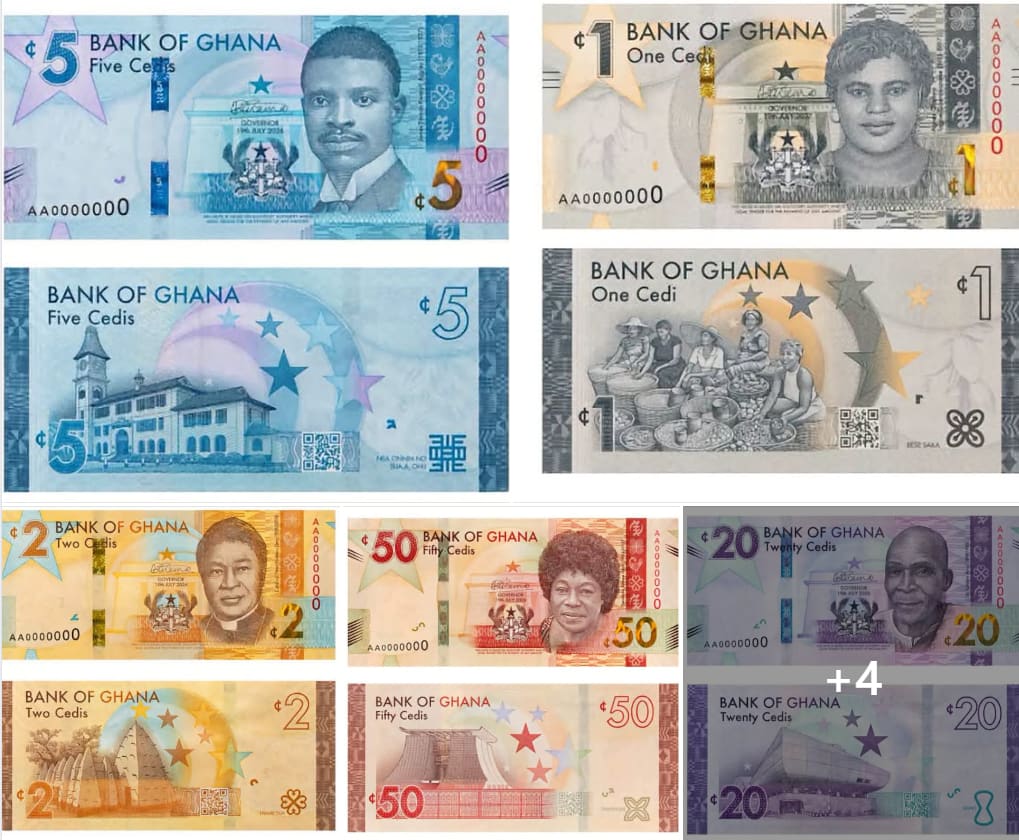
The Bank of Ghana will introduce the new Heritage Series banknotes into circulation from December 1, 2026, with existing Ghana cedi notes remaining legal tender and continuing to circulate alongside the upgraded currency.
Governor Dr Johnson Pandit Asiama announced the rollout at the official launch of the series at Bank Square in Accra on Thursday, November 12.
The redesigned banknotes come with enhanced security features, improved durability and more portable sizes as the central bank seeks to make counterfeiting more difficult while reducing the cost of managing physical currency.
“The Heritage Series will be introduced into circulation from 1 December 2026, and will circulate alongside the existing series, which remains legal tender,” Dr Asiama said.
He said allowing the two series to circulate together would avoid unnecessary disruption and give businesses and the public time to become familiar with the new notes.
Old cedi notes remain valid
The central bank stressed that the December rollout does not amount to an immediate withdrawal of existing banknotes.
There is therefore no requirement for individuals or businesses to rush to banks to exchange their current notes once the Heritage Series enters circulation.
The Bank says the transition will be managed gradually while maintaining continuity in Ghana’s payment system.
The redesigned notes incorporate national heroes, historic sites, monuments and Adinkra symbols as part of an effort to place Ghanaian history and cultural identity more visibly on the currency.
Dr Asiama said the notes were also built to withstand prolonged circulation and Ghana’s climatic conditions while giving the public clearer ways to identify genuine currency.
The Heritage Series forms part of the Bank’s wider currency modernisation programme ahead of its 70th anniversary in March 2027.
New Currency Act planned
The Bank of Ghana is also working with stakeholders on legislation to replace the Currency Act, 1964, Act 242.
The proposed Currency Act is expected to provide stronger penalties for counterfeiting and establish clearer procedures for detecting, surrendering, authenticating and destroying counterfeit notes.
It will also strengthen the legal framework against the mutilation, defacement and misuse of Ghanaian currency.
Dr Asiama said modern security features on banknotes must be supported by laws capable of protecting the currency.
The Bank has in recent months warned against practices such as deliberately damaging notes, spraying money at events and using banknotes for decorations.
Cedi App to help users identify notes
Alongside the new banknotes, the central bank is introducing a Cedi App to help the public learn the security and design features of the Heritage Series.
The application is also intended to assist visually impaired users in identifying banknotes.
The Bank will undertake a nationwide education campaign in major Ghanaian languages before and after the December rollout.
Additional Cash Centres are also planned for the Bank’s regional offices in Ho and Tamale, while an internally developed Enterprise Currency Operations Management Software will improve coordination between the central bank and commercial banks.
Despite the rapid expansion of digital payments, Dr Asiama said physical cash remains important to Ghana’s financial system, particularly during technical failures, cyber incidents or other interruptions to electronic payment channels.
For the Bank of Ghana, the Heritage Series is therefore not simply a redesign. It is part of a wider attempt to make physical currency more secure, durable and dependable while keeping the cedi relevant in an increasingly digital economy.
READ ALSO: 32% of Firms Ready to Invest in 24H+ Economy if Finance and Power Gaps Are Fixed