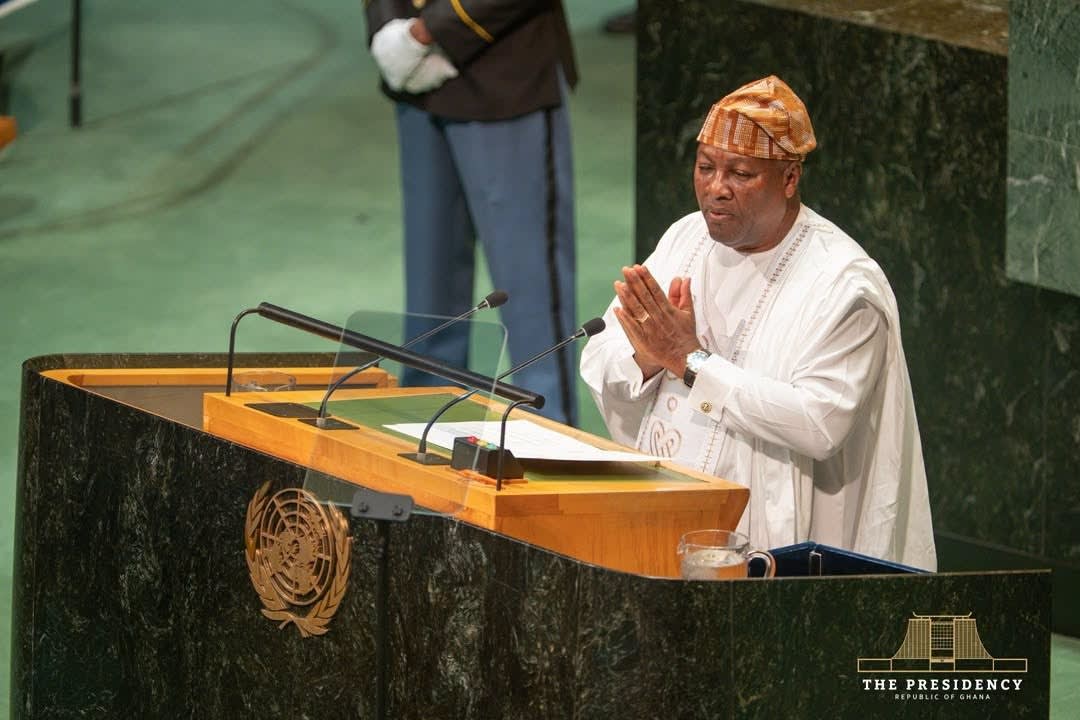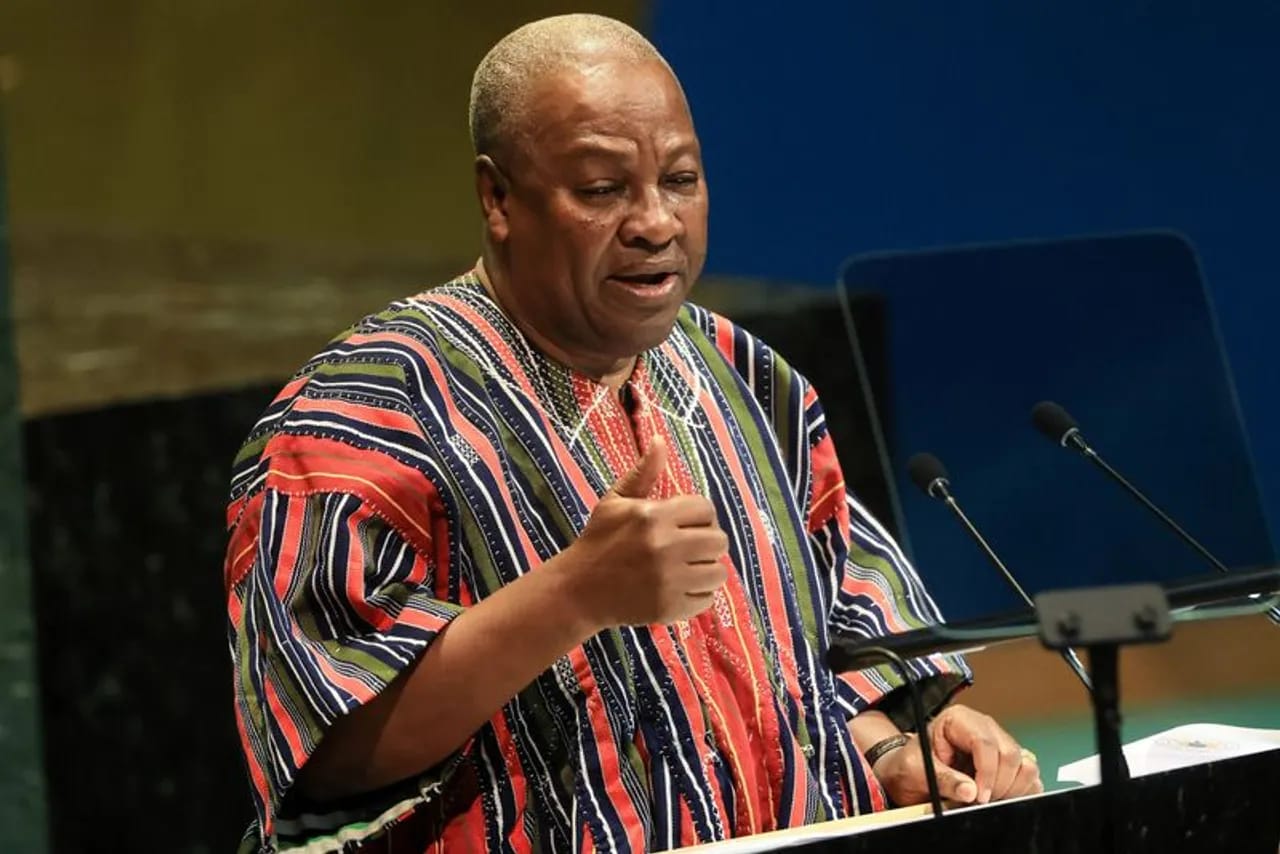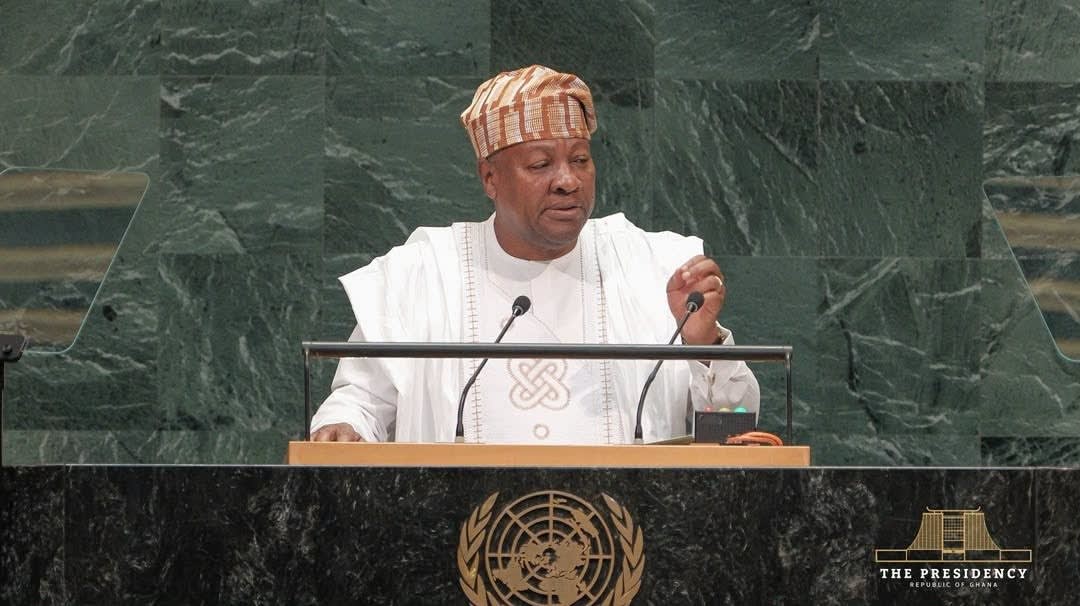
President John Dramani Mahama did not soften his language when the UN General Assembly turned to the conflicts consuming headlines worldwide. On Gaza, Sudan, and Cuba, Ghana's leader chose blunt words over diplomatic hedging.
Mahama's most emotionally charged passage centred on Gaza. He invoked the death of five-year-old Hind Rajab by name, alongside a broader toll he cited of more than 20,000 children killed in the conflict, and demanded the assembly confront the reality plainly rather than through sanitised language.
"We must stop using diplomatic euphemisms to veil the human carnage taking place in Gaza," he said. "How many more innocent lives must be lost before the world acts with decisive moral authority?"
He described collective punishment, enforced starvation, and mass displacement in the territory as flagrant violations of international law, and reaffirmed Ghana's recognition of the sovereign State of Palestine alongside its support for a two-state solution in which Israel and Palestine coexist with guaranteed, secure borders.
Mahama was careful to apply the same standard evenly, condemning all acts of terrorism by Hamas that triggered the conflict and insisting all parties respect international humanitarian law without exception. "Our moral standards cannot be selective," he said.
Renewing the Call on Cuba
In the same spirit, Mahama returned to a long-standing Ghanaian position on Cuba, calling for the immediate lifting of what he described as the decades-long economic, commercial, and financial embargo imposed on the island nation.
He urged the international community to support Cuba's new Economic and Social Programme, arguing that measures inflicting collective economic hardship on ordinary citizens run counter to shared commitments to human dignity and international law.
Sudan and the Sahel Left Behind
Mahama also pressed the assembly to elevate its response to Sudan, which he described as the site of the world's worst humanitarian crisis, and called for solidarity with nations confronting terrorism in the Sahel, specifically naming the Alliance of Sahel States.
"No human civilisation deserves to be annihilated," he said, "certainly not a member state of the United Nations"
He closed this section of his address with a broader principle intended to apply uniformly across every conflict he raised, whether in Europe, the Middle East, or Africa: respect for sovereign integrity, protection of civilians, unhindered humanitarian access, and accountability for war crimes.
READ ALSO: Mobile Money Transactions Hit GH¢518.8bn in August, Up 46.5% in One Year