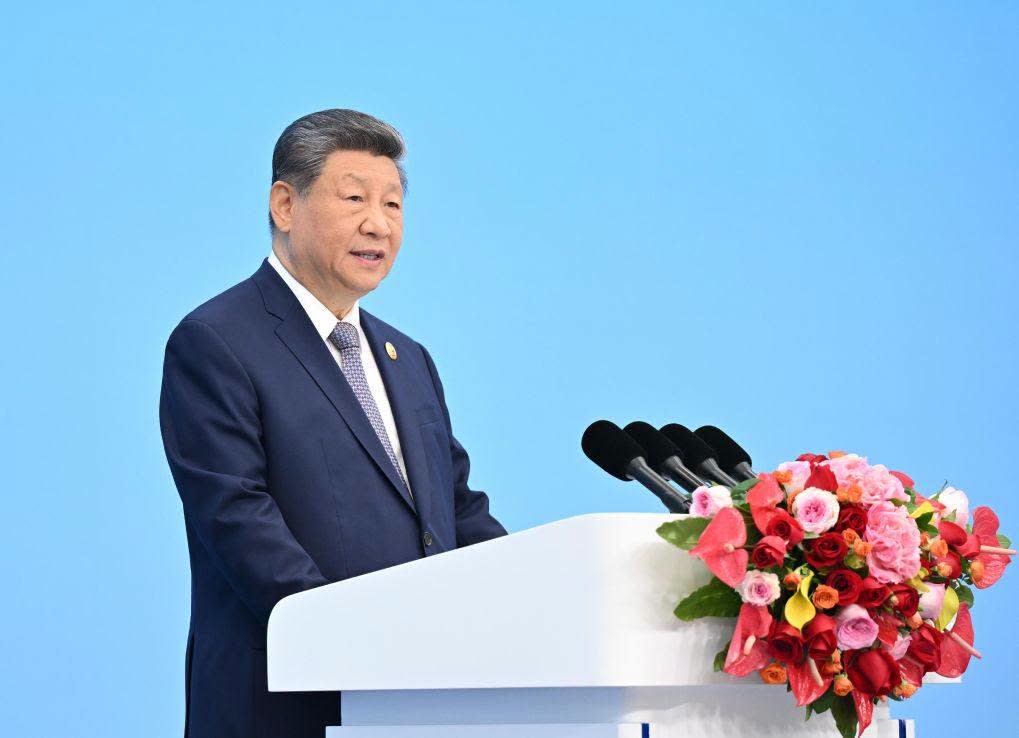
Chinese President Xi Jinping has invited global businesses to expand investment in China, promising wider market access, greater import opportunities and stronger support for innovation under the country’s new five-year development plan.
Speaking at the APEC CEO Summit in Shenzhen on Wednesday, November 18, President Xi said China investment opportunities would grow as the country deepens industrial upgrading, green technology, digitalisation and domestic consumption.
He described China’s 15th Five-Year Plan as both a domestic development blueprint and “an invitation for cooperation” to companies around the world.
China’s economy grew 4.6 percent in the first three quarters of 2026, according to figures cited by Mr Xi. He said growth was being supported increasingly by technology, advanced manufacturing and green industries.
China touts ‘super-sized’ consumer market
Mr Xi said China would continue opening its domestic market to foreign goods and services.
“China will provide global business communities with a super-sized open market,” he said.
He pointed to demand for new-energy vehicles, smart homes, services for older people and tourism as examples of markets expected to expand in the coming years.
China would also continue hosting its “Export to China” programmes and other trade events to help international companies access Chinese consumers.
The country is already the world’s second-largest consumer market and has what Beijing describes as the world’s largest middle-income population.
Mr Xi said the expansion of that consumer base could create opportunities for companies across the Asia-Pacific and beyond.
Innovation pitched as another opening
Technology was another major part of the investment pitch.
President Xi described China as a large testing ground where technologies including factory robots, agricultural automation, autonomous vehicles and drone delivery could be deployed, refined and commercialised.
He said the government would deepen links between technological research and industrial production.
Traditional industries would be upgraded while emerging industries and what Beijing calls “industries of the future” would receive greater policy support.
“China will provide global business communities with a promising land for development,” President Xi said.
The strategy reflects Beijing’s attempt to shift more economic activity towards higher-value manufacturing and technology as traditional sources of growth come under pressure.
Xi promises predictable business environment
Foreign businesses have repeatedly raised concerns about regulation, market access and the treatment of private investment in China.
President Xi sought to address those concerns directly.
He said China would work on reforms covering rules, regulation and standards in addition to cutting tariffs and widening market access.
The aim, he said, was to create a more stable and predictable environment for foreign companies operating in China.
Manufacturing would remain open to international firms, while the service sector would be opened further, he added.
China joined the World Trade Organization in 2001, the same year it first hosted an APEC leaders’ meeting.
President Xi said Beijing had fulfilled its WTO accession commitments and would continue supporting the multilateral trading system.
Reuters reported that President Xi’s speech presented China as a stable partner for international businesses while defending Beijing’s economic model at a time when trade tensions and technology restrictions remain high.
Belt and Road remains part of investment pitch
President Xi also reaffirmed China’s commitment to its Belt and Road Initiative.
He invited businesses from Asia-Pacific economies to participate in projects under the programme, which Beijing has used for years to support infrastructure, transport and trade links across several regions.
For foreign companies, the wider proposition is that China wants international capital and technology to remain involved in its next phase of industrial development.
That message carries extra weight as Beijing attempts to maintain investment flows while also building more domestic capacity in strategically important sectors.
APEC becomes stage for economic diplomacy
The Shenzhen gathering has brought together political leaders and senior executives at a time when trade and technology are increasingly tied to geopolitics.
Among the business leaders attending are executives from major Chinese and international companies, while the summit is taking place alongside wider APEC meetings involving leaders from across the region.
President Xi said business leaders had an important role in driving deeper economic integration.
He urged companies to pursue innovation, explore cross-border partnerships and participate in China’s continuing economic reforms.
“You are more than welcome to continue to get actively involved in China’s reform and opening up and modernization drive,” he said.
Growth model shifts towards technology
China’s economic strategy increasingly depends on higher-productivity sectors as growth moderates from the rapid rates recorded in previous decades.
President Xi said the new five-year plan would accelerate the development of what Beijing calls “new quality productive forces”, a policy concept centred on advanced technology, manufacturing and innovation.
The country is also pushing green transition and low-carbon industries, areas where Chinese companies already have large positions in solar manufacturing, batteries and electric vehicles.
For global companies, Beijing’s message is that those shifts will create business opportunities rather than close off the market.
The test will be how far policy changes on market access, regulation and competition translate into practical conditions for foreign investors.
President Xi said China remained committed to cooperation regardless of changes in the wider international environment.
His message to the business audience was that China’s next stage of development would not be pursued in isolation but with international companies invited to participate in its consumer, industrial and technology markets.
READ ALSO: UGEL CEO Defends GH¢8,000 Annual Hostel Fee