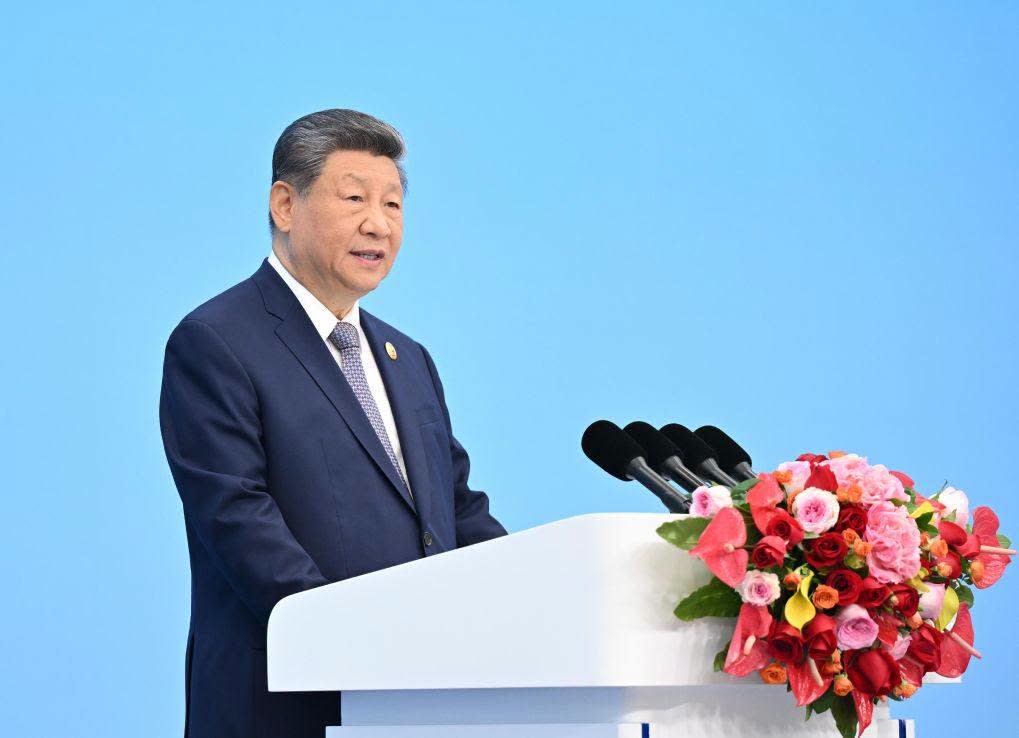
Russian President Vladimir Putin has described the Asia-Pacific economy as the new centre of global growth, arguing that the region’s expanding industrial, technological and consumer power is reshaping the international economic order.
Addressing business leaders at the APEC CEO Summit in Shenzhen, China, on Wednesday, November 18, Mr Putin said the region now accounts for more than 60 percent of global GDP and foreign direct investment, while also commanding a large share of world trade.
“The Asia-Pacific region has become the centre of the global economy and the world’s leading industrial and technological hub,” he said.
The Russian leader used the address to make a wider case for closer economic integration, stronger transport links and what he described as a more equal international order built around several centres of economic power.
His remarks came ahead of a closely watched trilateral meeting with Chinese President Xi Jinping and US President Donald Trump scheduled on the sidelines of the APEC summit. Reuters reported that Mr Putin said he expected significant benefit from the three-way talks.
Putin says sanctions have failed to isolate Russia
A substantial part of the address was devoted to Russia’s experience under Western sanctions.
President Putin argued that sanctions, tariffs and export restrictions could still slow economies but were no longer capable of completely stopping the growth of major competitors.
“The old instruments of economic domination and coercion have run their course and lost much of their power to intimidate,” he said.
He pointed to Russia as evidence of that argument, saying efforts to isolate the country had failed despite the scale of sanctions imposed since its invasion of Ukraine in 2022.
Independent reporting from the summit confirmed that President Putin portrayed Russia’s economic resilience as proof that Western sanctions had failed to achieve their intended isolation of Moscow.
The Russian President also criticised the European Union, arguing that cutting access to Russian energy and markets had contributed to pressure on industrial production, public finances and living standards in Europe.
Those comments represent President Putin’s assessment of Europe’s economic difficulties. The economic impact of sanctions and Europe’s move away from Russian energy remains a contested issue, with effects varying across countries and sectors.
Russia turns more trade towards Asia-Pacific
President Putin said Russia had sharply increased the share of its international trade conducted with Asia-Pacific economies over the past decade.
According to figures he presented, the region accounted for just over a quarter of Russia’s foreign trade in 2014. Moscow had initially set a long-term objective of raising that share to 40%. "It has now reached 53%", he said.
The shift reflects Russia’s deeper commercial ties with Asian economies as trade with several Western markets has been disrupted by sanctions and other restrictions.
President Putin called for APEC members to improve logistics and transport networks to accommodate the region’s growing trade and export capacity.
Russia, he said, was prepared to offer both land and maritime transit routes to businesses trading across Asia and Europe.
He argued that artificial barriers placed at any point in a supply chain eventually increase costs elsewhere, making connectivity and cooperation increasingly important as production networks become more integrated.
APEC pitched as platform for dialogue
The Russian president also presented APEC as a forum where major economies could continue talking despite geopolitical disagreements.
“In a contemporary world full of turbulence, amidst the fragmentation of the global economy, and at a time when military-political risks are on the rise,” partnership and dialogue were needed instead of isolation and confrontation, he told the summit.
He said leaders should use the forum to discuss political, economic and security disagreements while looking for compromises that protect wider economic stability.
That argument carries particular significance ahead of the planned meeting between Russia, China and the United States.
President Putin met President Xi separately in Shenzhen on Wednesday, with both leaders discussing deeper bilateral cooperation and broader international issues.
The APEC meeting comes as the global economy faces continued trade tensions, geopolitical conflicts and growing pressure on governments to secure supply chains in strategically important industries.
For Moscow, the summit also offers a platform to reinforce its economic pivot towards Asia and present Russia as a long-term partner in a region Putin believes will increasingly determine the direction of global trade and investment.
READ ALSO: Ghana Raises GH¢7.8bn in Gold Royalties Under New Sliding-Scale Regime