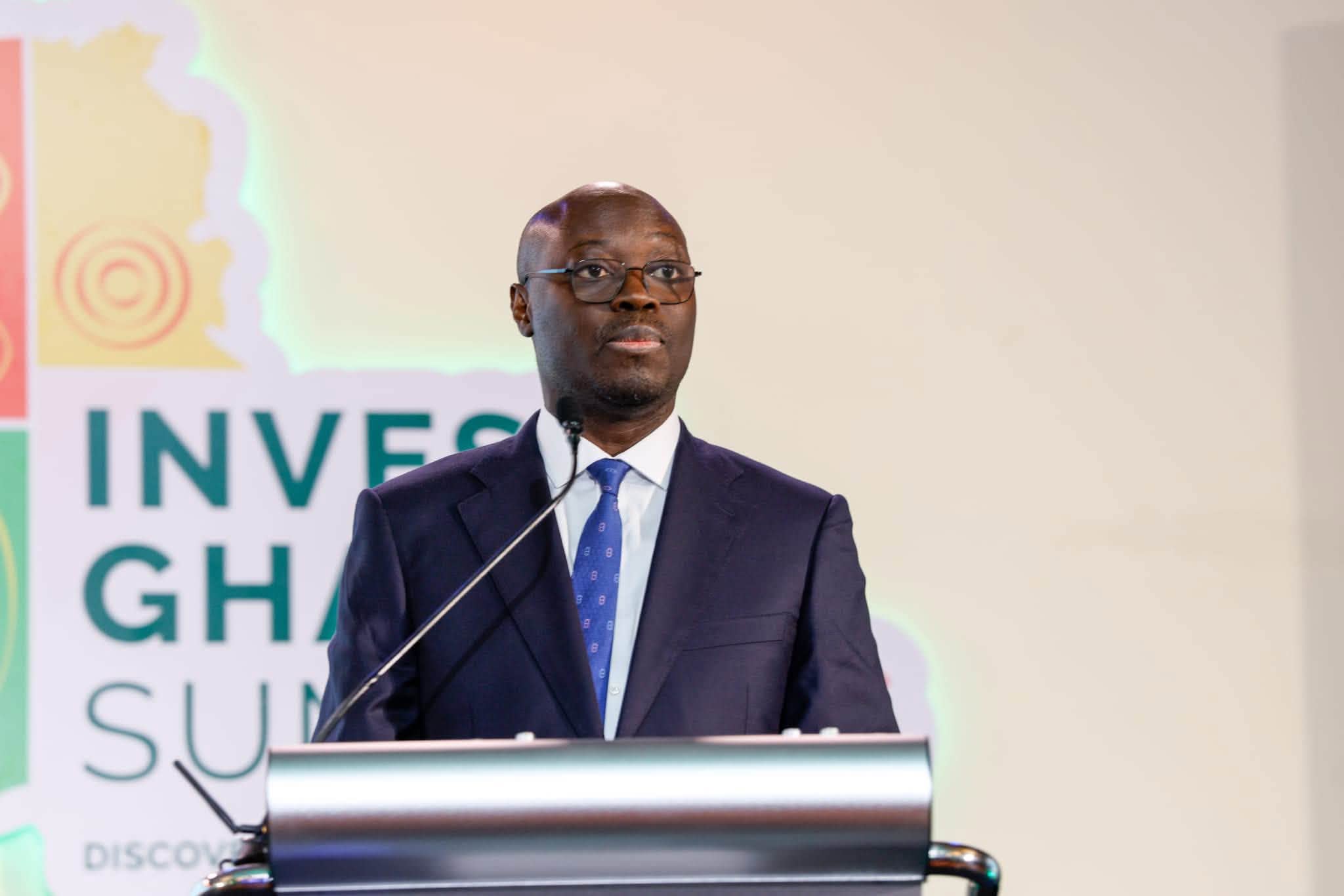
Finance Minister Dr Cassiel Ato Forson has invited local and international businesses to pursue New Economy investment opportunities in Ghana, produce locally and use the country as a base for reaching wider African markets.
The pitch is backed by a four-year government investment programme equivalent to US$10 billion between 2027 and 2030, aimed at moving the economy towards production, processing, exports and job creation.
Speaking at the Invest Ghana Summit in Accra, Dr Forson said government wanted investors to identify viable projects and work with Ghanaian businesses, banks and development finance institutions to turn them into commercial ventures.
“Ghana is ready to produce more at home and sell more to the world,” he said.
Infrastructure spending to support production
Government’s role under the programme is expected to centre heavily on infrastructure and public goods that can make private investment more commercially viable.
The 2027 Budget provides GH¢30 billion, equivalent to 1.5 percent of GDP, for the first year of the programme. Government says the spending will be directed towards productive infrastructure, industries and jobs while preserving macroeconomic stability.
Power, irrigation and transport are among the areas expected to influence whether factories can operate efficiently, farms can reach processors and manufacturers can compete on cost.
The broader New Economy framework covers eight areas, including commercial agriculture, energy infrastructure, critical minerals processing, textiles, pharmaceuticals, tourism and technology.
In agriculture, government is targeting integrated production systems around rice, poultry, maize, soybean, vegetables and other commodities.
The opportunity for investors extends beyond farming itself to irrigation, storage, milling, packaging, logistics and processing.
Investors will still test commercial viability
The size of government’s investment commitment does not, on its own, guarantee private capital.
Businesses will still have to assess infrastructure reliability, access to finance, regulatory certainty, market demand and the likely return on each proposed project.
That is particularly important for large industrial investments, where financing periods can extend well beyond the life of ordinary commercial loans.
Dr Forson has placed affordable finance and macroeconomic stability at the centre of the programme, arguing that investors need predictable inflation, exchange rates and borrowing conditions before committing long-term capital.
Government has also said every New Economy project will undergo appraisal and value-for-money assessment, with commitments budgeted and reported through the public finance system.
Minerals and manufacturing present openings
One area receiving attention is minerals processing.
Government plans to establish a critical minerals processing enclave in the Western Region to support local processing of resources including manganese and bauxite rather than exporting them largely in raw form.
Similar opportunities are being promoted in garment production, pharmaceuticals and technology services.
The commercial case is based on retaining more value in Ghana and creating businesses around supply, processing, transport and export.
But processing plants need more than raw materials. They also require dependable electricity, transport links, skilled labour, finance and customers.
That makes coordination across the programme critical.
AfCFTA widens the market
The African Continental Free Trade Area provides another part of government’s investment pitch.
Rather than build only for Ghana’s domestic market, businesses are being encouraged to consider regional demand when deciding where to locate production and how much capacity to install.
That could support larger factories and more specialised production, but firms will still have to compete on price, quality and delivery.
Dr Forson urged Ghanaian companies to present expansion projects they have struggled to finance and called on foreign investors to partner local businesses where possible.
The next test will be whether summit discussions move into firm agreements, financial close and construction.
For government, the US$10 billion commitment is meant to lower some of the barriers holding back production. Private investors will still have to provide much of the capital, expertise and commercial execution needed to make the projects work.
The success of the New Economy programme will therefore be measured less by the value announced and more by what eventually gets financed, built, operated and exported.
READ ALSO: Agriculture Minister Pushes Shift to Commercial Agriculture