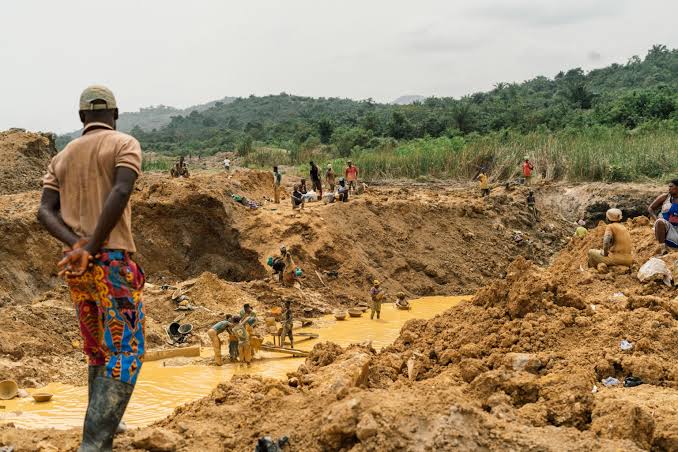
The European Union has warned that galamsey is undermining millions of euros in development investments across Ghana, including programmes in agriculture, water and sanitation, security and forest protection.
Deputy Head of the EU Delegation to Ghana Jonas Claes said the impact of illegal mining had pushed the bloc to become more directly involved in efforts to address the problem, after years of keeping its distance because of the political and institutional complexities surrounding the sector.
“Three to four years ago, the European Union did not have any engagement in this field. It was considered politically risky, too complex a problem,” Claes said.
“However, illegal mining is not only detrimental to the people of Ghana, but it also directly undermines EU interests and the EU-Ghana partnership.”
He was speaking at the public launch of three baseline studies under the EU-funded Gold for Good project.
EU investments under pressure
Claes said the EU commits substantial funding to programmes designed to improve livelihoods and protect Ghana’s natural resources, but damage caused by illegal mining threatens some of those investments.
“The EU spends sizeable programming funds towards sustainable agriculture, water sanitation, security and reforestation, all of which are gravely undermined by illegal mining practices,” he said.
The €3 million Gold for Good project is being implemented by Coginta and focuses on promoting responsible artisanal and small-scale mining while addressing environmental degradation, security concerns and weak governance in mining communities.
The initiative is operating in West Gonja Municipality, Bole District and Sawla-Tuna-Kalba District in the Savannah Region.
The EU said tackling galamsey would also require stronger public education, particularly in communities where mining provides immediate income and other economic benefits.
Security concerns emerge in northern Ghana
Coginta Ghana Country Director Rev. Fr. Dr Clement Aapengnuo also called for stronger natural resource governance, warning that poorly regulated mining could create wider security problems, particularly in northern Ghana.
The baseline studies found weaknesses in mining regulation and oversight, alongside environmental concerns in communities surveyed in the Savannah Region.
Aapengnuo said the way mineral resources are managed has implications beyond revenue, affecting livelihoods, community relations and long-term peace.
For the EU, the growing involvement in Ghana’s fight against illegal mining reflects that broader concern. The bloc wants mining communities to benefit economically without destroying the water, farmland and forests that other development programmes are trying to protect.
READ ALSO: CEMSE Calls for Alternative Mooring Facility to Lower Fuel Prices