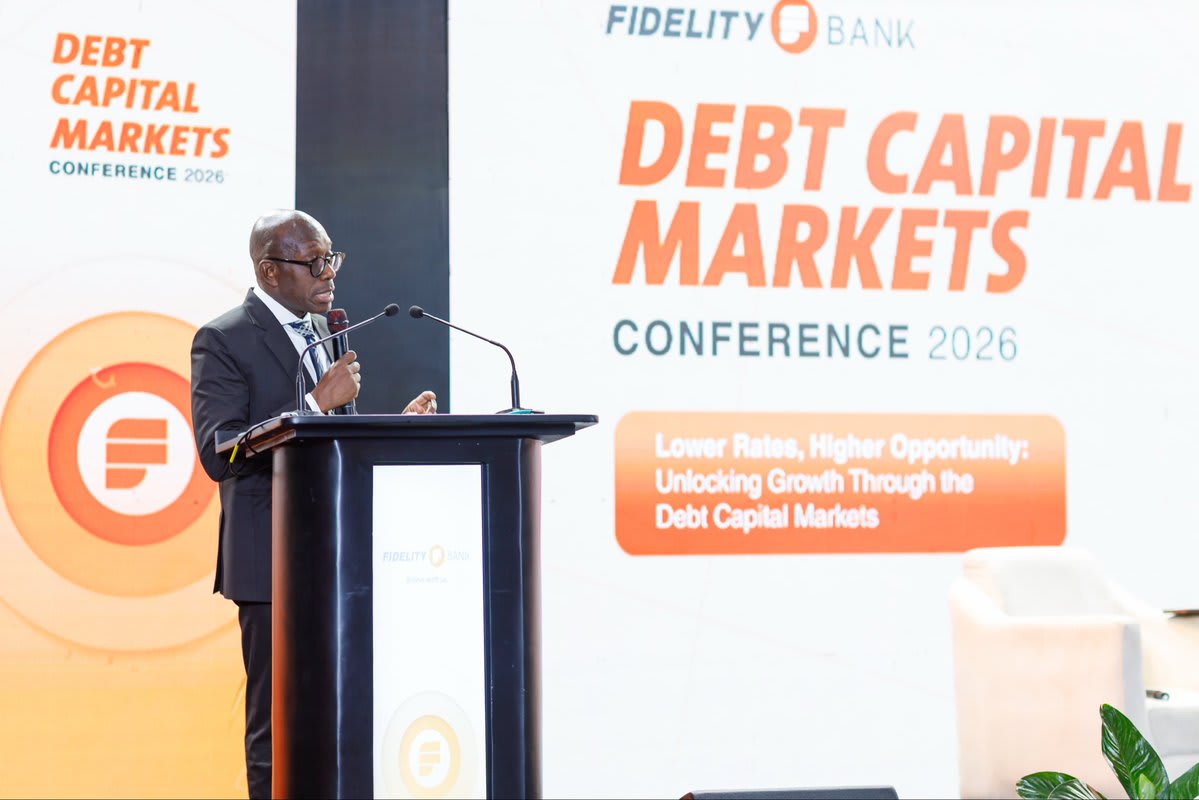
Fidelity Bank Ghana has brought together regulators, investors, issuers and financial market leaders to discuss how the Ghana debt capital market can convert improving macroeconomic conditions into cheaper, longer-term financing for businesses and major development projects.
The Debt Capital Markets Conference, held under the theme “Lower Rates, Higher Opportunity: Unlocking Growth Through the Debt Capital Markets,” drew participation from the Bank of Ghana, Ministry of Finance, Ghana Stock Exchange, Ghana Fixed Income Market, Securities and Exchange Commission and National Pensions Regulatory Authority.
For the participants, the discussion has shifted. Ghana has spent the past several years repairing macroeconomic fundamentals. The next question is what that stability actually finances.
Fidelity Calls for Wider Funding Channels
Fidelity Bank Managing Director Julian Opuni said improving economic indicators should ultimately translate into productive capital.
“The practical question is how we convert macroeconomic stability into efficiently priced, long-term capital for productive investment,” he said.
Mr Opuni argued that economic expansion cannot depend entirely on conventional bank lending or government securities.
Fidelity Bank, he said, has supported debt capital market transactions worth more than GH¢30 billion, giving it a direct interest in efforts to deepen the market.
“A deep debt capital market is built transaction by transaction, but it develops institution by institution,” he said.
BoG Sees Shift From Crisis Management
Bank of Ghana Governor Dr Johnson Pandit Asiama pointed to stronger economic indicators as evidence that conditions for rebuilding the capital market have improved.
Real GDP expanded by 6.4% in the first quarter of 2026, while headline inflation fell to 4.6% in July from 54.1% in December 2022. Gross international reserves stood at US$12.9 billion.
Dr Asiama described the reopening of the domestic bond market in March, following the expiry of restrictions associated with the Debt Exchange, as a major turning point.
“This is a milestone,” he said, describing it as a move “from crisis management to active, orderly debt management.”
But he cautioned that the real measure of success would not be auction volumes alone. The test, he said, is whether financing reaches power projects, factories, housing developments and businesses capable of creating jobs.
Corporate Debt Still Too Small
Ghana Stock Exchange Managing Director Abena Amoah said the Ghana Fixed Income Market has made significant progress since its establishment in 2015, but sovereign securities continue to dominate activity.
Corporate issuance remains a relatively small part of the market.
“A market built predominantly around one issuer cannot achieve its full potential without broader private-sector participation,” she said.
She challenged financial institutions to become more active both as bond issuers and as advisers helping corporate clients raise long-term funding.
That remains one of the biggest weaknesses in Ghana’s capital market. Government debt provides liquidity and benchmark pricing, but excessive sovereign dominance can leave fewer financing options for private companies.
Institutions Key to Sustaining Confidence
Veteran economist Kwame Pianim urged policymakers to protect the recent gains while directing domestic pension and insurance funds towards productive investment.
Dr Theophilus Acheampong, Technical Advisor at the Ministry of Finance, pointed to new fiscal rules, an independent Fiscal Council and a strengthened sinking fund as measures intended to prevent a return to fiscal instability.
Across the discussions, one point repeatedly surfaced: lower interest rates alone will not build a strong corporate bond market.
Investors will also demand credible issuers, transparent financial disclosures and stronger governance.
For Fidelity Bank, the conference is therefore about what comes after stabilisation. Ghana may now have an opportunity to rebuild longer-term finance, but the next stage depends on whether institutions can turn improving economic numbers into capital that actually reaches productive businesses and infrastructure.
READ ALSO: Cedi Projected to Trade Between GH¢10.95 and GH¢11.76 to Dollar in September