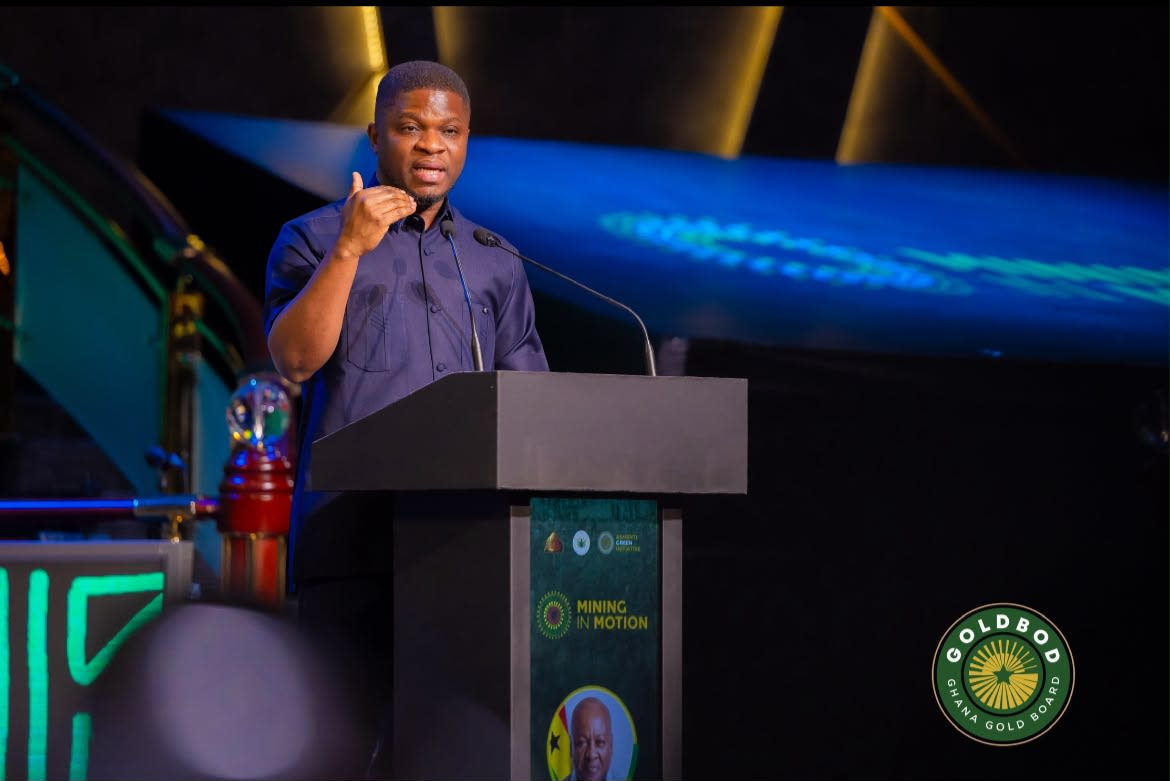
Ghana Gold Board Chief Executive Officer Sammy Gyamfi has defended ASM formalisation as a better response to some unlicensed mining operations, while insisting that mining in water bodies, forest reserves and dangerous areas within communities cannot be tolerated.
His clarification follows the circulation of a shortened video clip from his remarks on artisanal and small scale mining, which he said left out important context about the government’s approach to illegal mining.
Mr Gyamfi maintained that formalisation should not be extended to operations destroying rivers, encroaching on protected forests or taking place in areas such as roadsides, school lands and residential spaces where mining poses an immediate danger to communities.
For miners operating outside those prohibited areas, however, he argued that government should create a route into the regulated sector.
Formalisation Rather Than Military Action
According to Mr Gyamfi, an unlicensed artisanal mining operation located on a suitable mineralised area could potentially be brought under the Responsible Cooperative Mining and Skills Development Programme, provided it meets the required environmental and regulatory conditions.
“I maintain that formalising such unlicensed ASMs is a better approach than chasing them with soldiers,” he said.
The rCOMSDEP programme is government’s flagship initiative for reorganising artisanal and small scale mining through locally owned cooperatives, professional training, legal concessions and access to shared processing facilities.
A nationwide registration exercise has also been underway to bring artisanal miners into legally recognised cooperatives and assess the viability of proposed mining areas before concessions are approved.
Mr Gyamfi said the intention is to help eligible miners obtain the licences, permits, certifications and technical training needed to operate responsibly rather than leave them permanently outside the formal economy.
‘Regulation Must Be Firm but Practical’
The GoldBod CEO linked his position to remarks delivered at the African Minerals Policy Forum, Mining in Motion 2026, where he argued that enforcement alone would not create a sustainable small scale mining industry.
“Regulation must be firm, but also practical, inclusive and commercially sound,” he said.
He added that mining regulation should “do more than police miners” by building capacity and creating lawful economic opportunities for people already participating in the sector.
GoldBod’s broader strategy includes traceability systems intended to identify the source of gold and distinguish responsibly sourced production from gold potentially linked to environmentally destructive mining.
The Board is preparing a system that will track gold from its mine of origin through aggregation, processing and export.
GoldBod Plans Financing Support in 2027
Mr Gyamfi also confirmed that GoldBod intends to introduce an Artisanal and Small Scale Mining Formalisation and Financing Support Programme in 2027.
The programme will be implemented with the Ministry of Lands and Natural Resources and the University of Mines and Technology, with technical support from South Africa’s Rand Refinery. It is expected to combine formalisation with financing, technical assistance and improved mining practices.
“We at the GoldBod hold the view that properly organised small scale mining offers one of the clearest pathways from mineral ownership in law to indigenous ownership in practice.” - Mr Gyamfi
The policy distinction he is drawing is therefore between mining government considers incapable of being regularised because of where and how it occurs, and unlicensed operators who could potentially be brought under regulation.
Enforcement against environmentally destructive mining continues alongside that formalisation drive. NAIMOS says it carried out 738 operations between June and September 2026, particularly targeting illegal activity around water bodies, forest reserves and other sensitive areas.