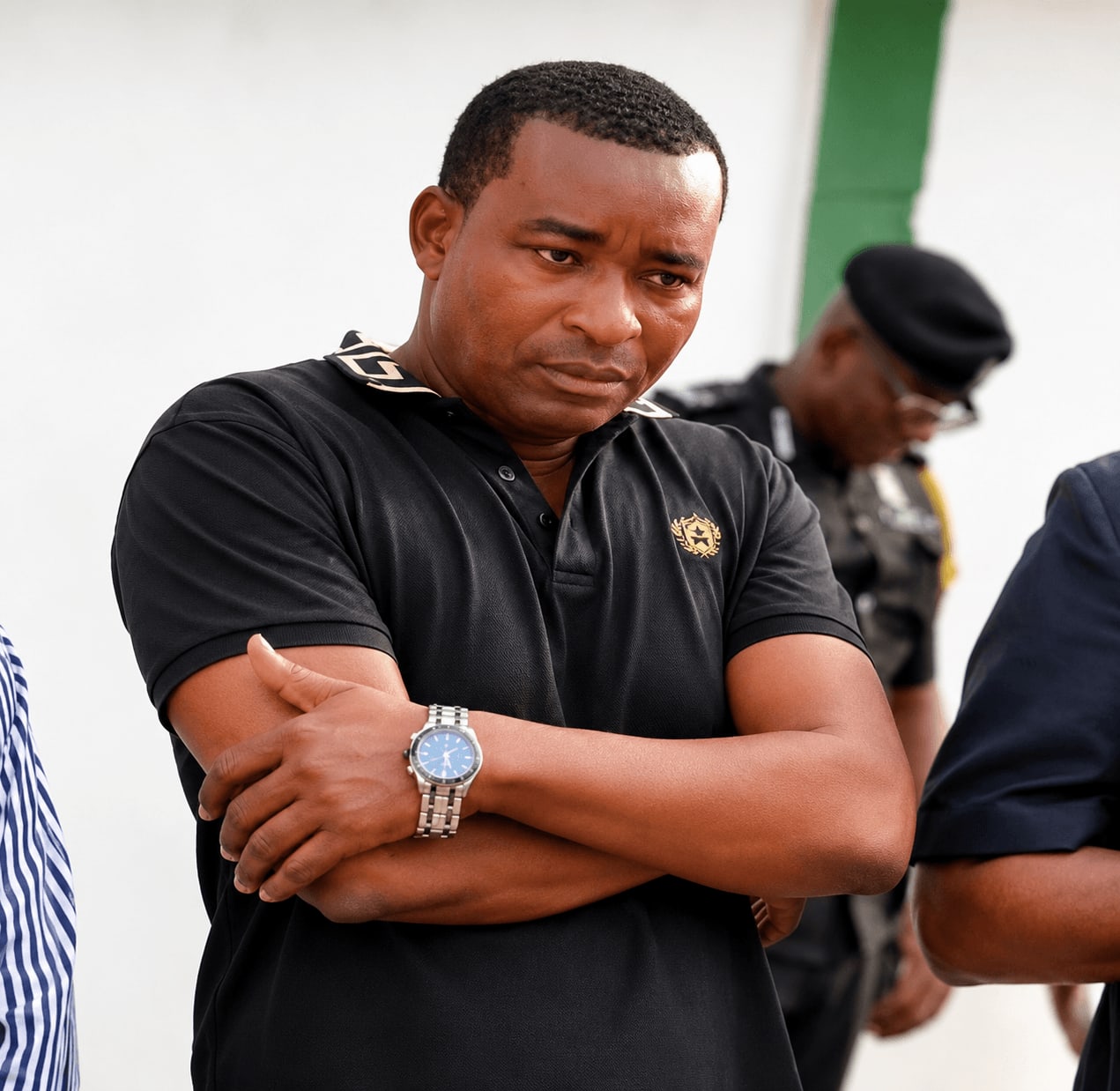
Ashanti Regional Chairman of the New Patriotic Party (NPP), Bernard Antwi Boasiako, popularly known as Chairman Wontumi, has been sentenced to 20 years' imprisonment after the High Court in Accra found him guilty of offences linked to illegal mining on the concession of Akonta Mining Limited at Samreboi in the Western Region.
Justice Audrey Kocuvie-Tay imposed a 20-year custodial sentence on each of the two counts for which Wontumi was convicted, ordering that the sentences run concurrently. The court also fined him 10,000 penalty units on each count.
Akonta Mining Limited, which stood trial alongside its chairman, was convicted on two separate counts and fined 15,000 penalty units for each offence after the court concluded that the prosecution had proved its case beyond reasonable doubt.
Court rejects last-minute bid to halt judgment
The sentencing followed the dismissal of a last-minute application by the defence seeking to postpone judgment and refer constitutional questions to the Supreme Court.
Lawyers for Wontumi had argued that Section 99(2)(b) of the Minerals and Mining Act required constitutional interpretation. Justice Kocuvie-Tay disagreed, ruling that the law was "clear and unambiguous" and did not conflict with the fair trial provisions of the 1992 Constitution.
Quoting the decision in R v. Mainkankan, the judge held that constitutional references are only justified where genuine ambiguity exists.
"The issue raised by counsel is that Parliament ought to have legislated differently. That is not a matter for constitutional interpretation," the court ruled.
Illegal transfer of mining rights established
The court found that Akonta Mining, through Wontumi, unlawfully dealt with its mineral rights by allowing another individual, Henry Okum, to undertake mining activities on the concession without the approval of the Minister responsible for Lands and Natural Resources.
According to the judgment, the prosecution successfully established that the company held valid mineral rights, those rights were effectively transferred for mining purposes and no ministerial approval had been obtained.
"The allegation was never contested. The accused admitted that no ministerial approval was received," Justice Kocuvie-Tay observed while delivering the ruling.
The defence insisted that Mr Okum had only been contracted to reclaim degraded portions of the concession. The court was not persuaded.
Instead, it relied heavily on Mr Okum's testimony that he was permitted to mine sections of the concession and use proceeds from the mining activity to finance reclamation works. The judge noted that this aspect of the evidence remained largely unchallenged during cross-examination.
The explanation that Mr Okum would later recover his investment through coconut farming was dismissed as "an afterthought."
Court lifts corporate veil
One of the more significant aspects of the judgment centred on Akonta Mining's corporate structure.
Although companies ordinarily enjoy a separate legal identity, the court held that the circumstances justified lifting the corporate veil.
Justice Kocuvie-Tay found that Akonta Mining lacked a functional board and that Wontumi exercised effective control over the company's mining operations, making him personally liable for offences committed through the company.
The court also convicted both Wontumi and Akonta Mining of purposefully facilitating unlawful mining, finding that they enabled Mr Okum to carry out mining activities without the approvals required under Ghana's mining laws.
Evidence before the court further showed that Wontumi introduced Mr Okum to an individual who assisted him in acquiring an excavator used for the mining operations, a fact the judge considered evidence of deliberate facilitation.
Convictions mark major illegal mining prosecution
The High Court convicted Chairman Wontumi on Count One, assigning mineral rights without ministerial approval, and Count Four, purposefully facilitating unlawful mining activities.
Akonta Mining Limited was convicted on Counts Three and Six relating to the same offences.
The convictions were secured under the Minerals and Mining Act, 2006 (Act 703), as amended by the Minerals and Mining (Amendment) Act, 2020 (Act 995), bringing to a close one of Ghana's most closely watched illegal mining prosecutions.
READ ALSO: Monetary Policy Committee Begins Crucial Meeting as Inflation, Cedi Stability Take Centre Stage